
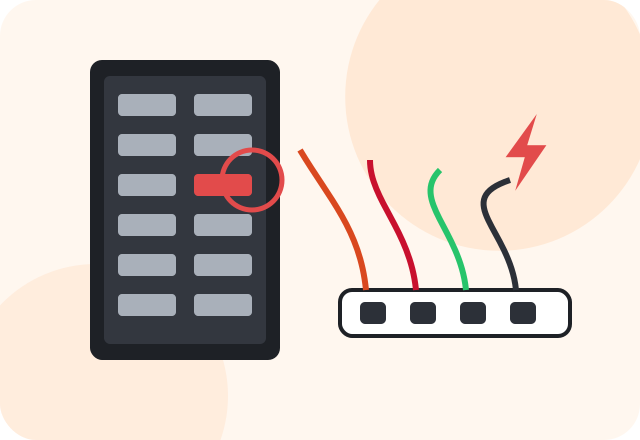
What homeowners usually notice
- The handle feels mushy or springs back to the middle when you push it to ON.
- The breaker holds for a few seconds or minutes, then trips again.
- The air conditioner or heat pump breaker won't stay on during a hot afternoon.
- The dryer breaker trips each time the dryer heats up, even though the drum still turns at first.
What to do right now
- Push the tripped handle firmly all the way to OFF first; most breakers will not reset from the middle position.
- Unplug lamps, electronics and appliances on that circuit, or switch off the appliance at its own control.
- Try the breaker once. If it trips again right away, leave it off.
- Do not hold the handle in the ON position, tape it, or swap in a larger breaker.
Likely causes
Overloaded circuit
Space heaters, window units, hair dryers and a microwave on one circuit can add up past its rating. The breaker may reset only after the load comes off.
Appliance fault
A failing air conditioner compressor, condenser fan motor or dryer heating element can pull heavy current the moment it starts, so the breaker trips again as soon as the appliance calls for power.
Short or ground fault in the wiring
Damaged insulation, a loose wire or a nail through a cable can create a fault path. A breaker on a shorted circuit will not stay on no matter how many times you try.
Worn or failing breaker
Breakers age, and after many trips or heat from a loose connection one may stop latching or trip below its rating.
Hot connection at the panel
A loose lug or corroded bus contact heats the breaker, and a hot breaker trips more easily. Discoloration or a warm cover is a warning sign.
Safe checks you can make
- Note exactly which breaker it is and what it feeds (the panel label, or which rooms went dark).
- Check whether it trips instantly, after a few seconds, or only when a specific appliance runs.
- Feel the panel cover with the back of your hand for unusual warmth, without opening it.
- Listen for buzzing and sniff for a hot plastic smell near the panel or the appliance.
Leave outlet covers, switch plates and the panel cover in place. Noting what you see and hear is enough; testing inside boxes belongs to an electrician.
Is this something you can fix yourself?
If the breaker holds once you unplug a space heater or move a second window unit to another circuit, you probably found the problem: the circuit was overloaded, and spreading the load out is a reasonable fix. What you should not try to solve yourself is a breaker that won't latch at all, one that trips with everything unplugged, or an air conditioner breaker that keeps tripping. Those point to a fault in the wiring, the equipment or the breaker, and each needs testing behind panels homeowners should leave closed.
When professional help is the right call
- It trips again with nothing plugged in and every switch off.
- The handle will not latch at all, or it feels loose and floppy.
- The breaker, panel cover or a nearby outlet feels warm or smells hot.
- Your AC or dryer breaker trips repeatedly across several days.
- You hear buzzing or crackling from the panel when you try it.
Safety first. Stop trying the breaker if it trips instantly more than once, if you see scorch marks, or if you smell burning plastic. Repeated resets push fault current through the circuit each time. If there is smoke, sparking or heat that keeps building at the panel or an outlet, get everyone out of the house and call 911.
What an electrician typically checks
An electrician usually starts by isolating the circuit: disconnecting loads, then testing the wiring for shorts and ground faults with the breaker off. They check the breaker's connection to the bus, the tightness of the wire terminal, and whether the breaker size matches the wire and the appliance nameplate.
Depending on what they find, the fix may be a new breaker through circuit breaker replacement, repairing a damaged run of cable, or adding a dedicated circuit so a heavy appliance stops sharing.
Keeping it from coming back
Give big loads their own circuits, keep space heaters off circuits that already run a microwave or window unit, and clean dryer vents. In Birmingham summers the air conditioner works hard for months, so a quick look at its disconnect and wiring during routine HVAC service is worth it. If breakers keep tripping around the house, an electrical inspection can show whether the panel is simply undersized for how the home is used now.