
Lights Blinking in House Birmingham AL: What It Means for Your Home’s Wiring, HVAC, and Safety
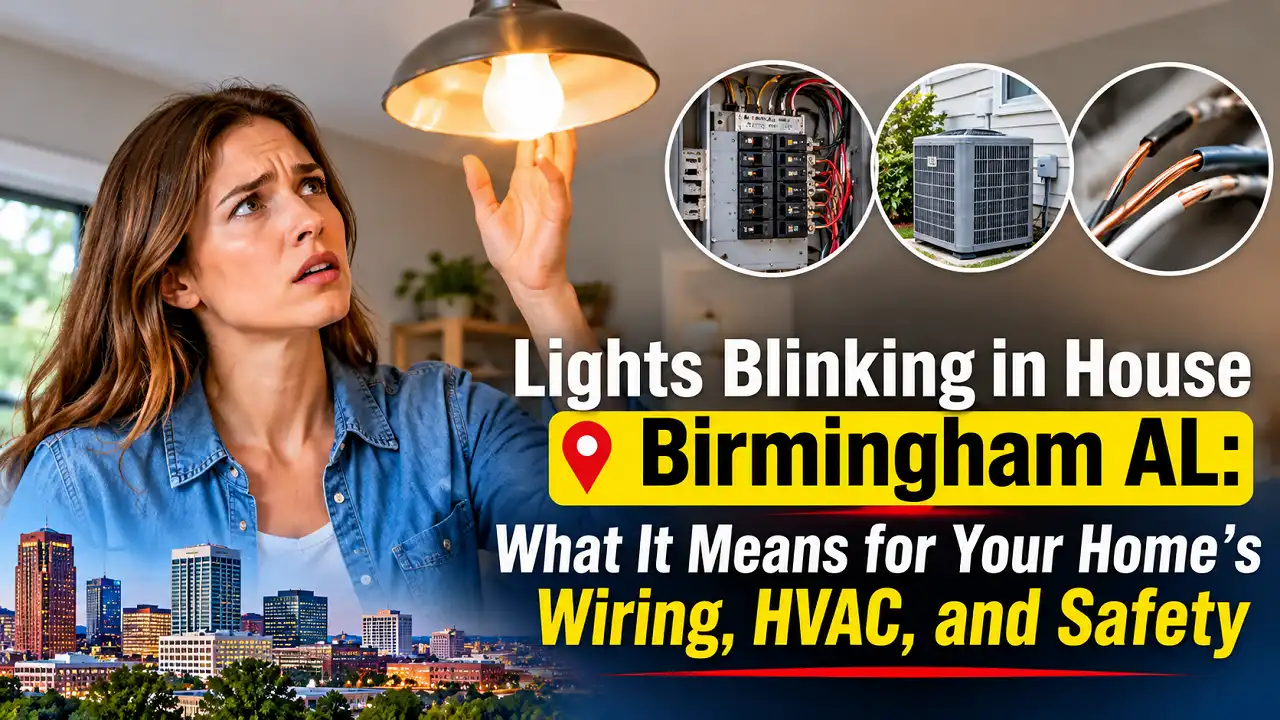
Your kitchen lights dip every time the AC kicks on. The porch light stutters after a summer storm. If you’ve noticed lights blinking in house Birmingham AL homes like yours, the cause can be minor or serious. A blink can come from a loose bulb, a struggling AC compressor, or a failing wire connection hiding behind a wall. The pattern of the blink tells you which one you’re dealing with.
That difference matters, because loose connections are a leading source of electrical fires in residential homes.
Key Takeaways
- One blinking light usually points to a bulb, fixture, or dimmer problem. Whole-house blinking points to your panel, service connection, or the utility.
- A brief dim when your AC starts is common. A deep, long dip suggests an undersized circuit, a weak compressor, or a loose neutral that needs a licensed electrician.
- Warning signs like burning smells, warm switch plates, buzzing, or blinking in older homes with aluminum wiring call for professional help right away.
Why Lights Blink: What Our Electricians Find on Real Service Calls
This section explains the most common causes we find and how to tell them apart. On recent service calls across Jefferson and Shelby counties, we’ve traced blinking lights to everything from a $3 bulb to a corroded service lug at the meter. Most homeowners guess wrong at first, and that’s normal.
Our network of licensed Birmingham electricians sees the same patterns over and over. Here’s how the causes break down.
Causes vs. Fixes at a Glance
| Cause | Typical Symptom | Risk Level | Common Fix |
|---|---|---|---|
| Loose bulb | One light flickers | Low | Tighten or replace bulb |
| Faulty fixture or socket | One fixture blinks, even with new bulb | Low to Medium | Repair or replace fixture |
| Incompatible dimmer | LEDs flicker at low settings | Low | Install LED-rated dimmer |
| Loose wire connection | Blinking plus warm switch or buzzing | High | Re-terminate connections |
| Overloaded circuit | Lights dim when appliances run | Medium | Add a dedicated circuit |
| Failing breaker | Lights on one circuit blink or cut out | Medium to High | Replace breaker |
| HVAC startup surge | Lights dip when AC or heat pump starts | Low to Medium | Soft start kit or dedicated circuit |
| Loose neutral | Some lights brighten while others dim | Critical | Emergency repair |
| Utility voltage fluctuation | Whole house blinks, neighbors too | Varies | Report to the utility |
| Aluminum wiring | Random blinking in 1965 to 1973 homes | High | Pigtail or rewire |
Loose Wiring and Connections
Loose connections are the cause we worry about most. Wires loosen over time from heat cycling, vibration, and poor original installation. A loose wire creates arcing, which produces heat. That heat can ignite insulation or framing long before a breaker ever trips.
Watch for these signs:
- Warm or discolored switch plates and outlet covers
- Buzzing or crackling from a switch or outlet
- Burning plastic smell near a fixture
- Blinking that gets worse over weeks
Overloaded Circuits
Many older Birmingham homes run lights and outlets on shared 15-amp circuits. Add a space heater, hair dryer, or window unit, and the voltage sags. Lights on that circuit dim or blink as a result. A dedicated circuit for heavy appliances usually solves it.
Failing Breakers
Breakers wear out. A worn breaker can develop poor contact with the panel bus bar. That causes blinking on one circuit, heat at the panel, and sometimes nuisance tripping. Certain older panel brands have known reliability issues, and we recommend having them evaluated.
Check Also: Double Tapped Breaker Birmingham AL: What It Means for Your Panel, HVAC System, and Home Safety
Lights Blinking in House Birmingham AL When the AC Turns On
This section covers the HVAC link most homeowners never consider. If you’ve spent a summer in Alabama, you know your AC runs almost nonstop from May through September. Every single start pulls a big burst of current.
Why AC Startup Causes Voltage Dips
An AC compressor draws locked rotor amps (LRA) when it starts. That’s often 3 to 6 times its normal running current, for a fraction of a second. If your service wires, panel, or circuits can’t absorb that surge, the voltage drops. Your lights show it first.
| HVAC Equipment | Typical Running Amps | Typical Startup Surge (LRA) | Blink Likelihood |
|---|---|---|---|
| 2-ton AC condenser | 9 to 12 A | 45 to 60 A | Low to Medium |
| 3-ton AC condenser | 13 to 17 A | 70 to 85 A | Medium |
| 4 to 5-ton AC condenser | 18 to 26 A | 100 to 130 A | Medium to High |
| Heat pump with aux heat strips | 20 to 60 A total | High during defrost | High in winter |
| Ductless mini-split (inverter) | 5 to 15 A | Soft ramp-up, minimal | Very Low |
| Variable-speed central system | Varies | Soft ramp-up | Very Low |
Normal Dip vs. Problem Dip
A quick, faint dim that lasts under a second is usually normal. A deep dip, a long dip, or a dip that affects the whole house deserves a closer look.
- Normal: Lights dim slightly for a split second when the AC starts
- Concerning: Lights dim noticeably and stay dim for 1 to 3 seconds
- Serious: Some lights brighten while others dim (possible loose neutral)
- Serious: Blinking gets worse during heat waves
Winter Heat Pump Blinking
Our winter temperature drops bring a different issue. Heat pumps turn on electric resistance strips during cold snaps and defrost cycles. Those strips can pull 40 to 60 amps at once. On an older 100-amp service, that’s a major load.
HVAC-Related Fixes
| Fix | What It Does | Typical Birmingham Cost (2026) |
|---|---|---|
| Hard start kit | Helps compressor start faster | $150 to $400 installed |
| Soft start kit | Cuts startup surge by up to 60 to 70% | $350 to $750 installed |
| Dedicated HVAC circuit correction | Fixes undersized or shared wiring | $300 to $900 |
| Service lug and meter connection repair | Fixes loose main connections | $200 to $600 |
| Panel/service upgrade (100A to 200A) | Adds capacity for HVAC and EV loads | $2,000 to $4,500+ |
A soft start kit is one of the most cost-effective fixes we recommend for older homes with big AC units. It also reduces wear on the compressor.
Whole House vs. Single Light: Reading the Blink Pattern
This section helps you narrow the cause before you call anyone. Where the blinking happens tells us a lot. So does when it happens.
Symptom Severity Table
| What You See | Likely Cause | Severity | What to Do |
|---|---|---|---|
| One bulb flickers | Loose or failing bulb | Low | Tighten or replace |
| One room blinks | Circuit, switch, or breaker | Medium | Schedule an inspection |
| Lights dim with appliances | Overloaded circuit | Medium | Consider a dedicated circuit |
| Whole house blinks | Service connection or utility | High | Call an electrician and utility |
| Lights brighten and dim unevenly | Loose neutral | Critical | Turn off sensitive electronics and call now |
| Blinking plus burning smell | Arcing connection | Emergency | Shut off breaker and call immediately |
Lights Blinking in House Birmingham AL Today: Utility or Your Wiring?
If you’re dealing with lights blinking in house Birmingham AL today, check outside first. Severe storms, wind, and tree contact with lines are common here. Alabama Power handles issues on the utility side of your meter.
Quick check:
- Ask a neighbor if their lights are blinking too.
- Check the utility outage map for your area.
- Look at the service drop (the wires to your house) for sagging or tree contact.
- Note the time and what was running when it happened.
If neighbors have the same issue, it’s likely a utility voltage fluctuation. Normal residential voltage should stay close to 114 to 126 volts on a standard 120-volt circuit. If only your house is affected, the problem is likely at your meter base, service entrance, or panel.
Check Also: Aluminum Wiring in House Birmingham AL: What It Means for Your Safety, Comfort, and Repair Budget
Older Birmingham Homes: Aluminum Wiring and Aging Panels
This section is for homeowners in older neighborhoods. Our certified electricians frequently see this in older Birmingham homes, especially in parts of Fairfield, Bessemer, Homewood, and established areas across the city. Age alone doesn’t mean danger. But age plus blinking lights is a pattern we take seriously.
The Aluminum Wiring Problem
Many homes built between roughly 1965 and 1973 used single-strand aluminum branch wiring. Aluminum expands and contracts more than copper. Over decades, that movement loosens connections at outlets and switches. Loose aluminum connections overheat, oxidize, and cause blinking.
Signs of aluminum wiring:
- Wire jackets marked “AL” or “ALUMINUM” (visible in the panel or attic)
- Silver-colored wire at outlets
- Home built in the mid-1960s to early 1970s
- Warm outlets or random flickering across several rooms
Older Wiring Types and Risks
| Wiring Type | Common Era | Blinking Risk | Recommended Action |
|---|---|---|---|
| Knob-and-tube | Before 1950 | High | Plan a rewire |
| Early cloth-insulated NM | 1950s to 1960s | Medium to High | Inspect and update |
| Single-strand aluminum | 1965 to 1973 | High | Pigtail with approved connectors or rewire |
| Modern copper NM-B | 1970s to present | Low | Routine inspection |
Panel Concerns
Older panels may lack the capacity for modern loads. Think central AC, EV chargers, and big kitchens. Worn bus bars and loose main lugs can cause whole-house blinking. Our team handles panel upgrades and breaker repairs for homes that have outgrown their original service.
The National Electrical Code (NFPA 70) sets the standards for safe wiring methods, connections, and panel installations across the country. You can review it through the NFPA 70 National Electrical Code page. Local jurisdictions adopt specific editions, so permits and inspections follow those local rules.
LED Lights Blinking in House Birmingham AL: The Driver and Dimmer Problem
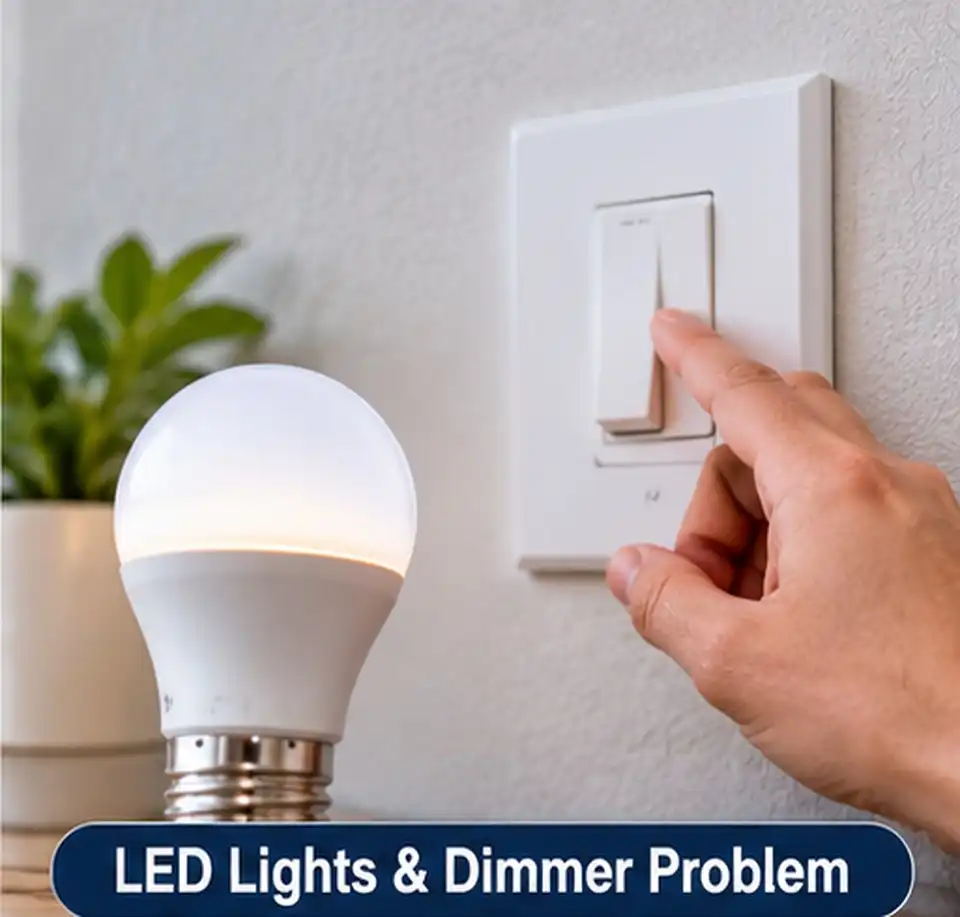
This section explains why new LED bulbs sometimes blink worse than old incandescents. LEDs are efficient and long-lasting. But they’re also more sensitive to voltage changes and dimmer types. Many calls about LED lights blinking in house Birmingham AL turn out to be a compatibility issue, not a wiring failure.
Why LEDs Flicker
Every LED has a small driver inside. The driver converts household AC power into the steady DC power the LED needs. A cheap or overheated driver is the most common reason LEDs flicker.
Common LED flicker causes:
- Old incandescent dimmers that don’t work with LED loads
- Low-quality drivers in budget bulbs
- Heat buildup in enclosed fixtures or recessed cans
- Mixed bulb brands on one dimmer
- Minimum load issues when too few LEDs sit on a dimmer
- Voltage dips from HVAC or appliances
LED Problem Troubleshooting Table
| LED Symptom | Likely Cause | DIY Fix | Pro Fix |
|---|---|---|---|
| Flickers only when dimmed | Incompatible dimmer | Use non-dimmable setting or full brightness | Install LED-rated dimmer ($100 to $250) |
| Flickers in enclosed fixture | Driver overheating | Use bulbs rated for enclosed fixtures | Replace fixture if heat persists |
| Blinks when AC starts | Voltage sensitivity | Try higher-quality bulbs | Address circuit or HVAC surge |
| Strobes rapidly | Failing driver | Replace bulb | Check fixture wiring |
| Glows faintly when off | Leakage current or lighted switch | Replace lighted switch | Add neutral wire or load bypass |
| Integrated LED fixture blinks | Built-in driver failure | None | Replace driver or fixture ($150 to $450) |
Choosing Better LED Bulbs
The U.S. Department of Energy recommends checking that LED bulbs are labeled for use with dimmers and enclosed fixtures when needed. Their LED lighting guidance from the Department of Energy covers efficiency and performance basics. ENERGY STAR certified bulbs also meet flicker and dimming performance standards.
Quick LED buying checklist:
- Look for “dimmable” if it’s on a dimmer
- Look for “enclosed fixture rated” for closed globes
- Stick with one brand per dimmer circuit
- Check the dimmer maker’s compatibility list
- Choose ENERGY STAR certified products when possible
LED Pros and Cons
Pros:
- Uses up to 75% less energy than incandescent bulbs
- Lasts 15 to 25 times longer
- Produces far less heat, which helps during Alabama summers
Cons:
- More sensitive to voltage dips
- Can flicker with older dimmers
- Cheap drivers may fail early in hot attics or enclosed fixtures
Check Also: GFCI Protection Birmingham AL: What the 2026 Code, Humid Summers, and Older Wiring Mean for Your Home
Outdoor Lights Blinking in House Birmingham AL: Weather, Moisture, and Sensors
This section covers exterior lighting problems, which have their own set of causes. Central Alabama’s humidity, heavy rain, and summer heat are hard on exterior fixtures. If you’re seeing outdoor lights blinking in house Birmingham AL properties, moisture is often to blame.
Common Outdoor Causes
Water and electricity are a bad mix, and outdoor fixtures face both every day. Here’s what we usually find:
- Water intrusion in fixture housings or junction boxes
- Corroded sockets from humidity and pollen buildup
- Failing photocells that confuse dusk and dawn
- Motion sensor faults triggered by wind, branches, or bugs
- Loose GFCI connections on outdoor circuits
- Low-voltage landscape transformers that are overloaded
- Damaged underground wiring from digging or roots
Outdoor Lighting Fixes and Costs
| Outdoor Problem | Signs | Typical Fix | Typical Cost (2026) |
|---|---|---|---|
| Water in fixture | Blinks after rain | Reseal or replace fixture | $150 to $400 |
| Corroded socket | Green or white crust in socket | Replace socket or fixture | $125 to $350 |
| Failing photocell | Cycles on and off at dusk | Replace sensor | $100 to $250 |
| Motion sensor fault | Random flashing at night | Adjust or replace sensor | $100 to $275 |
| Bad GFCI | Outdoor lights cut in and out | Replace GFCI receptacle | $150 to $300 |
| Landscape transformer issue | Path lights dim or blink | Replace or resize transformer | $200 to $600 |
| Damaged buried wire | Section of lights fails | Locate and repair cable | $300 to $1,200+ |
Outdoor Maintenance Checklist
Use this list each spring and fall:
- Check fixture gaskets for cracks or gaps.
- Clean pollen and debris from fixtures and sensors.
- Test GFCI outlets with the test and reset buttons.
- Trim branches near motion sensors.
- Inspect visible wiring for chewed or cracked insulation.
- Confirm bulbs are wet-location rated for exposed fixtures.
We provide outdoor lighting repairs throughout the metro area. You can check our Birmingham-area service locations to confirm coverage in Pelham, Helena, Alabaster, Chelsea, and nearby communities.
Step-by-Step Troubleshooting You Can Safely Do
This section gives you safe checks before calling for help. These steps don’t require opening walls, panels, or fixtures. If any step makes you uneasy, stop and call a licensed electrician.
Safe DIY Steps
- Tighten the bulb. Turn off the switch first and let the bulb cool.
- Swap the bulb. Try a new, quality bulb from a known brand.
- Test another lamp. Plug a lamp into the same circuit to see if it blinks too.
- Watch the timing. Note if blinking matches the AC, fridge, washer, or microwave.
- Check the dimmer. Set it to full brightness and see if blinking stops.
- Ask neighbors. Find out if they see blinking at the same time.
- Look at the panel door. Note any warm breakers, buzzing, or scorch marks. Don’t remove the cover.
- Reset GFCIs. Press reset on outdoor, bathroom, and garage GFCIs.
When to Stop and Call a Pro
Call right away if you notice:
- Burning smell or smoke
- Warm or hot switch plates, outlets, or panel
- Sparks or crackling sounds
- Lights brightening and dimming in different rooms at once
- Breakers tripping repeatedly
- Aluminum wiring in your home
- Whole-house blinking that only affects your home
Repair vs. Replace: Making the Right Call
This section helps you weigh short-term fixes against long-term upgrades. Some problems need a quick repair. Others signal that your system has hit its limit.
We always give homeowners an honest, clear breakdown of both paths.
Repair vs. Replace Comparison
| Component | Repair When | Replace When | Typical Lifespan |
|---|---|---|---|
| Light fixture | Loose socket or wire | Corrosion, heat damage, or failed integrated LED | 15 to 25 years |
| Switch or dimmer | Loose terminal | Worn, warm, or incompatible with LEDs | 15 to 25 years |
| Breaker | Loose connection to bus | Worn, hot, or trips under normal load | 25 to 40 years |
| Electrical panel | Minor lug or bus issues | Recalled brand, damaged bus, undersized service | 25 to 40 years |
| Aluminum branch wiring | Pigtail with approved connectors | Widespread overheating or damage | Connections degrade over time |
| Whole-house wiring | Isolated problems | Knob-and-tube, brittle insulation, frequent faults | 50 to 70 years |
Full Cost Comparison for Blinking Light Repairs
| Service | Typical Birmingham Cost Range (2026) | Time Needed |
|---|---|---|
| Diagnostic service call | $100 to $200 | 1 hour |
| Switch or outlet repair | $125 to $275 | 1 hour |
| LED-compatible dimmer install | $100 to $250 | 1 hour |
| Fixture replacement | $150 to $450 | 1 to 2 hours |
| Breaker replacement | $150 to $350 | 1 to 2 hours |
| Dedicated circuit install | $300 to $900 | Half day |
| Aluminum wiring remediation | $1,500 to $4,500 (whole home) | 1 to 3 days |
| Panel upgrade to 200A | $2,000 to $4,500+ | 1 day |
| Whole-house rewire | $8,000 to $20,000+ | 1 to 3 weeks |
Costs vary by home size, access, permit fees, and parts availability. A written estimate after diagnosis is always the best number to trust.
How Our Electricians Diagnose Blinking Lights
This section shows what happens when a licensed electrician arrives. A good diagnosis saves you money. It keeps you from paying for fixes you don’t need.
Our process typically includes:
- Interview: We ask when, where, and how often blinking happens.
- Voltage testing: We measure voltage at outlets and the panel, under load and at rest.
- Panel inspection: We check breakers, bus bars, main lugs, and the neutral bar.
- Thermal scan: Infrared cameras find hot connections inside walls and panels.
- Circuit load check: We confirm circuits aren’t overloaded.
- HVAC review: We check the condenser circuit and startup behavior.
- Written findings: You get clear options, ranked by safety priority.
On a recent call in Hoover, a homeowner thought her new LED bulbs were defective. We found a loose neutral at the meter base. It was causing voltage swings of nearly 20 volts whenever the AC started. Fixing it took under two hours and protected her electronics and HVAC system.
FAQs
Is it dangerous if my lights blink?
It depends on the pattern. A single blinking bulb is usually harmless. Blinking with heat, smells, buzzing, or across the whole house can be dangerous and needs an inspection.
Why do my lights dim when my AC turns on?
Your AC compressor draws a large startup surge. A brief dim is common. A long or deep dim points to undersized wiring, loose connections, or a struggling compressor.
Can blinking lights damage my appliances?
Yes. Repeated voltage swings stress electronics, refrigerators, and HVAC control boards. A loose neutral can send high voltage to some circuits and fry devices.
Why are my new LED lights blinking?
Most often it’s an incompatible dimmer, a cheap driver, or heat buildup in an enclosed fixture. Switching to LED-rated dimmers and quality bulbs fixes most cases.
Who do I call: the utility or an electrician?
If neighbors have the same issue, call Alabama Power. If only your home is affected, call a licensed electrician. Issues at the meter base or panel are usually the homeowner’s responsibility.
Do outdoor lights blink more in summer?
Often, yes. Humidity, storms, and heat speed up corrosion and moisture problems. Sensors also react to bugs and wind more in warmer months.
Should I worry about aluminum wiring?
If your home was built between 1965 and 1973, have it checked. Aluminum wiring isn’t always unsafe, but its connections need approved repair methods to prevent overheating.
How much does it cost to fix blinking lights?
Simple fixes run $100 to $300. Circuit or breaker work runs $150 to $900. Panel upgrades and rewiring cost more, as shown in the tables above.
Get Lights Blinking in House Birmingham AL Problems Fixed the Right Way
Blinking lights are your home’s way of flagging a problem. Most causes are simple and affordable to fix. Some, like loose neutrals and aluminum wiring, need prompt attention. Waiting rarely makes an electrical problem cheaper.
Start with the safe checks above. Note when the blinking happens and whether it lines up with your AC. If you see warning signs or the cause isn’t obvious, bring in a pro.
At Birmingham AL Electrician, we connect you with independent, licensed electricians who work 7 days a week across Birmingham, Fairfield, Bessemer, Pelham, Helena, Alabaster, Chelsea, and surrounding areas. If you’re dealing with lights blinking in house Birmingham AL homeowners can’t explain, schedule a licensed electrical inspection and get clear answers, honest pricing, and a safer home.