
GFCI Protected Birmingham AL Homes: What the 2026 NEC Means for Your Kitchen, Garage and HVAC

One small outlet can stop a shock that would otherwise stop a heart. A GFCI (ground-fault circuit interrupter) cuts power in about 1/40 of a second when it senses roughly 5 milliamps of current leaking where it shouldn’t. Getting a home fully GFCI protected Birmingham AL inspectors will approve now covers far more than bathrooms.
The 2023 National Electrical Code (NEC) extends protection to laundry areas, basements, ranges, dryers and the outdoor equipment that runs your heat pump or AC condenser.
For property owners, a missing GFCI is a failed inspection, a stalled home sale or a real shock hazard.
Important Highlights
- The 2023 NEC Article 210.8 requires GFCI protection in kitchens, bathrooms, garages, outdoors, basements, crawl spaces, laundry areas and within 6 feet of any sink.
- One GFCI device can protect an entire branch circuit. A GFCI breaker or a properly wired GFCI outlet protects every outlet downstream of it.
- Test every GFCI monthly with its TEST button. A unit that won’t trip or won’t reset needs replacement, and repeated tripping often points to a wiring or moisture fault.
What GFCI Protection Does and Why It Matters
GFCI protection prevents electrocution, not fires. The device compares current on the hot wire with current on the neutral wire. If the two differ by about 4 to 6 milliamps, power shuts off. That gap means electricity is leaking through water, a damaged cord or a person.
A standard circuit breaker works differently: it trips only on overloads or short circuits, often at 15 or 20 amps. That’s thousands of times more current than it takes to injure someone. A breaker protects the wiring; a GFCI protects the people.
How GFCI Protection Works in Central Alabama Conditions
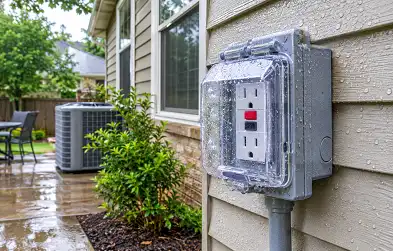
Humidity changes the picture here. Birmingham summers push relative humidity well past 70% for weeks. Condensation forms inside outdoor boxes, garage outlets and crawl space wiring. That moisture creates tiny leakage paths, and a working GFCI reacts to them.
The independent electricians in our network see this pattern every July. Outdoor GFCIs trip after an afternoon storm, then reset fine once the box dries out. The trip is the device doing its job. The fix is usually a better cover, not a different outlet.
Where GFCI Protected Outlets Are Required Under the 2023 NEC
The 2023 NEC lists every dwelling location in Article 210.8(A). This is where GFCI protected outlets are required for 125-volt through 250-volt receptacles on single-phase circuits rated 150 volts or less to ground. That range now includes many 240-volt receptacles, such as dryer and range outlets in covered areas.
The National Fire Protection Association (NFPA) publishes the NEC and tracks which edition each state and city enforces. You can review its electrical safety resources and adoption maps through the NFPA electrical safety and NEC resource center.
NEC 2023 GFCI Required Locations for Dwellings
| Location | NEC 2023 Reference | What Must Be Protected | Birmingham-Area Notes |
|---|---|---|---|
| Bathrooms | 210.8(A)(1) | All receptacles | Includes half baths and powder rooms |
| Garages and accessory buildings | 210.8(A)(2) | All receptacles | Covers detached shops and storage buildings |
| Outdoors | 210.8(A)(3) | All receptacles | Porches, decks, patios, soffit outlets |
| Crawl spaces | 210.8(A)(4) | Receptacles at or below grade | Common under older Jefferson County homes |
| Basements | 210.8(A)(5) | Finished and unfinished | Hillside homes often have walk-out basements |
| Kitchens | 210.8(A)(6) | All receptacles, not just countertop | Includes fridge and disposal outlets |
| Food or beverage prep areas with a sink | 210.8(A)(7) | All receptacles | Wet bars, butler’s pantries, outdoor kitchens |
| Sinks | 210.8(A)(8) | Within 6 ft of the bowl edge | Applies in any room |
| Boathouses | 210.8(A)(9) | All receptacles | Lay Lake and Logan Martin docks |
| Bathtubs and shower stalls | 210.8(A)(10) | Within 6 ft of the outside edge | Includes bedrooms with open-plan tubs |
| Laundry areas | 210.8(A)(11) | All receptacles, including dryer | Washer and 240V dryer outlets |
| Indoor damp and wet locations | 210.8(A)(12) | All receptacles | Mudrooms, utility rooms, unfinished storage |
| Specific appliances | 210.8(D), 422.5(A) | Dishwashers, ranges, wall ovens, cooktops, dryers, microwaves, sump pumps | Hardwired units count |
| HVAC service receptacles | 210.8(E), 210.63 | Receptacles serving equipment in attics and crawl spaces | Required near air handlers and condensers |
| Outdoor outlets (not just receptacles) | 210.8(F) | Outlets up to 50A, including hardwired equipment | Affects AC condensers and heat pumps |
| Pools, spas and hot tubs | Article 680 | Pump motors, lighting, nearby receptacles | Bonding rules apply too |
Readily accessible placement matters as well. Since the 2020 edition, the GFCI device itself must be easy to reach for testing. A GFCI hidden behind a refrigerator or dishwasher doesn’t meet that rule.
GFCI Protected Birmingham AL Homes: What the 2026 NEC Means for Your Kitchen, Garage and HVAC
The HVAC Integration Issue Every Homeowner Should Know
Section 210.8(F) is the rule that affects your heating and cooling system. It requires GFCI protection for outdoor outlets, which includes the hardwired disconnect feeding your condenser or heat pump. Some inverter-driven heat pumps leak small amounts of current through their drive electronics. That leakage can trip a GFCI with no actual fault present.
The 2023 NEC gave listed HVAC equipment a temporary exception. That exception expired on September 1, 2026. Any new or replaced outdoor unit permitted after that date may need GFCI protection where the 2023 edition is enforced.
If you’ve spent a summer in Alabama, you know a tripped condenser in August is not a minor inconvenience. Before a system replacement, ask your HVAC contractor and electrician three questions:
- Confirm the code edition your city or county enforces.
- Ask whether the new unit is listed as compatible with GFCI protection.
- Plan the disconnect and breaker together so the electrical and HVAC work pass one inspection.
A whole-home electrical inspection that maps every GFCI and code gap is the fastest way to know where your house stands before a remodel, sale or HVAC upgrade.
The GFCI Protected Outlet Code in Alabama and Birmingham

Alabama does not run one statewide residential electrical code. Local jurisdictions adopt their own NEC edition and amendments. The City of Birmingham, Hoover, Pelham, Alabaster and unincorporated Jefferson and Shelby county areas each set their own permit rules. That’s why the GFCI protected outlet code for your address depends on where your permit is pulled.
How Code Editions Affect Your Home
| Situation | Which GFCI Rules Apply | What It Means for You |
|---|---|---|
| Existing home, no work planned | Code in effect when built | No required upgrade, though upgrades are strongly advised |
| Replacing a receptacle in a GFCI-required location | Current adopted code (NEC 406.4(D)(3)) | The replacement must be GFCI protected |
| Remodeling a kitchen, bath or laundry | Current adopted code for the remodeled area | New GFCI and AFCI rules apply to that space |
| New construction | Current adopted code, whole house | Full 210.8 compliance at final inspection |
| Home sale | Code at build date, plus inspector findings | Buyers’ inspectors flag missing GFCIs constantly |
The replacement rule surprises many homeowners. Under NEC 406.4(D)(3), swapping a worn bathroom or kitchen outlet triggers today’s GFCI requirement. The old outlet can’t simply be replaced like-for-like. The new one must be GFCI protected.
What We See Across Jefferson and Shelby Counties
On recent service calls across Jefferson and Shelby counties, the same gaps come up again and again:
- Bessemer and Fairfield: Two-prong outlets in kitchens and baths with no grounding and no GFCI.
- Older Birmingham homes near Southside, Crestwood and Ensley: Basement and crawl space outlets that were never protected.
- Pelham and Alabaster subdivisions: One garage GFCI feeding outdoor and bathroom outlets, which confuses owners when everything goes dead.
- Helena and Chelsea newer builds: Laundry and dryer outlets installed before the 2023 rules took effect locally.
Most GFCI protected Birmingham AL homes built after 2000 have the basics covered. Laundry, dryer and range outlets are the usual misses.
GFCI Protected Branch Circuit: How One Device Protects Many Outlets
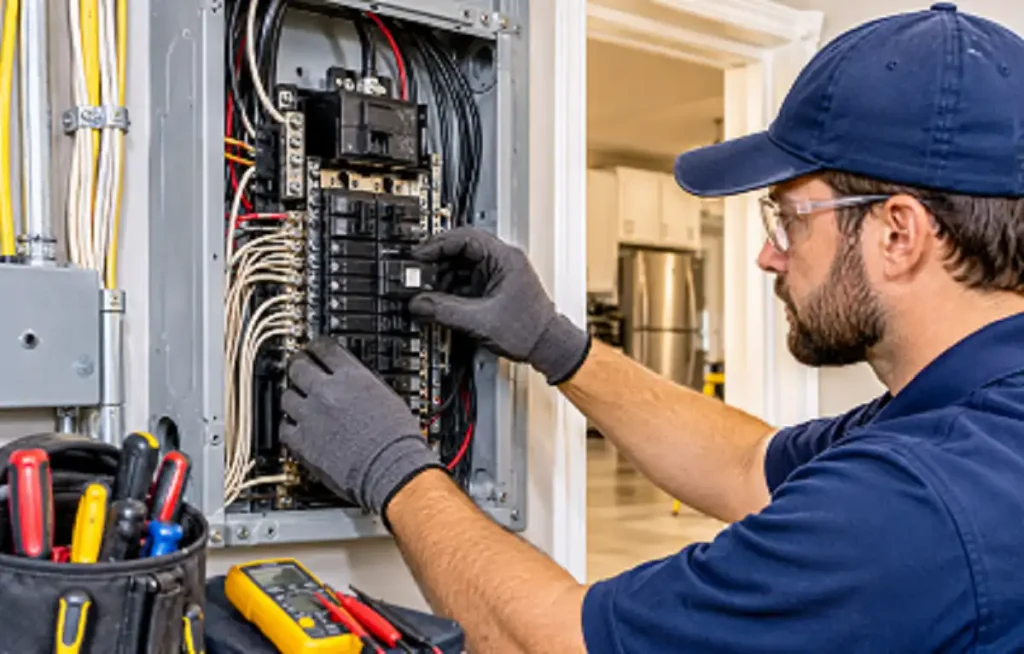
A GFCI protected branch circuit is a circuit where one GFCI device protects every outlet wired after it. You don’t need a GFCI receptacle at every location. One correctly placed device covers the whole downstream run.
Two Ways to Protect a Branch Circuit
- Install a GFCI breaker in the panel. It protects the entire circuit from the panel outward, including every receptacle and hardwired load.
- Install a GFCI receptacle at the first outlet. Wire the incoming power to the LINE terminals and the outgoing cable to the LOAD terminals. Every outlet past it is now protected.
Miswired LINE and LOAD terminals are a common DIY mistake. Modern GFCIs won’t reset if LINE and LOAD are reversed, which is a built-in safety check. Older units could appear to work while leaving downstream outlets unprotected.
Labeling Downstream Outlets
The NEC requires downstream receptacles to carry a “GFCI Protected” label in certain replacements. This sticker tells the next person where the protection lives. Without it, homeowners hunt for a reset button that’s two rooms away.
| Branch Circuit Feature | GFCI Breaker | GFCI Receptacle (First Outlet) |
|---|---|---|
| Protects | Entire circuit from panel | That outlet plus all LOAD-side outlets |
| Reset location | Electrical panel | At the outlet |
| Best for | Hardwired appliances, 240V loads, HVAC disconnects | Kitchens, baths, garages with easy access |
| Readily accessible? | Yes, if panel is accessible | Yes, if not behind an appliance |
| Nuisance trip troubleshooting | Harder, whole circuit drops | Easier, narrower zone |
Panels from the 1970s and 1980s don’t always accept modern GFCI breakers. Federal Pacific, Zinsco and some discontinued brands have limited or no listed options. A licensed electrician handling circuit breaker replacement with the correct listed GFCI or dual-function breaker will confirm compatibility before ordering parts.
Double Tapped Breaker Birmingham AL: What It Means for Your Panel, HVAC System, and Home Safety
GFCI Device Types: Receptacle, Breaker and Portable
Three device types deliver GFCI protection. Each fits a different job. Choosing the wrong one creates nuisance trips, access problems or failed inspections.
GFCI Device Comparison
| Device Type | Typical Device Cost | Typical Installed Cost (Birmingham Area) | Lifespan | Best Use |
|---|---|---|---|---|
| Standard GFCI receptacle (15A or 20A) | $15 to $30 | $120 to $250 | About 10 years | Bathrooms, kitchens, single locations |
| Weather-resistant (WR) GFCI receptacle | $25 to $45 | $150 to $300 with in-use cover | 7 to 10 years outdoors | Porches, patios, pool areas |
| GFCI breaker (single-pole) | $40 to $120 | $150 to $350 | 15+ years | Full branch circuit, hard-to-reach loads |
| Dual-function AFCI/GFCI breaker | $50 to $130 | $175 to $375 | 15+ years | Kitchens and laundry areas |
| 2-pole GFCI breaker (240V) | $90 to $200 | $250 to $500 | 15+ years | Hot tubs, pool pumps, condensers |
| Portable GFCI (plug-in or cord) | $15 to $40 | No install needed | Varies | Temporary use, tools, holiday lights |
Prices are typical 2026 ranges. Final quotes depend on panel brand, wire condition, access and permit fees.
Pros and Cons: GFCI Receptacle vs. GFCI Breaker
GFCI receptacle pros:
- Lower cost per location
- Reset button right where the trip happens
- Easy to add during a bathroom refresh
GFCI receptacle cons:
- Takes up more box space, a tight fit in old metal boxes
- Outdoor units wear faster in Alabama humidity
- Can be blocked by appliances, breaking the accessibility rule
GFCI breaker pros:
- Protects the whole circuit, including hardwired loads
- Device stays dry and protected inside the panel
- Required approach for many 240-volt loads
GFCI breaker cons:
- Higher cost per circuit
- Reset requires a trip to the panel
- Not available for every older panel brand
When the job calls for new receptacles in a garage, porch or kitchen island, professional electrical outlet installation makes sure each one lands on the right circuit with the right protection.
GFCI vs. AFCI: What Each Protects Against
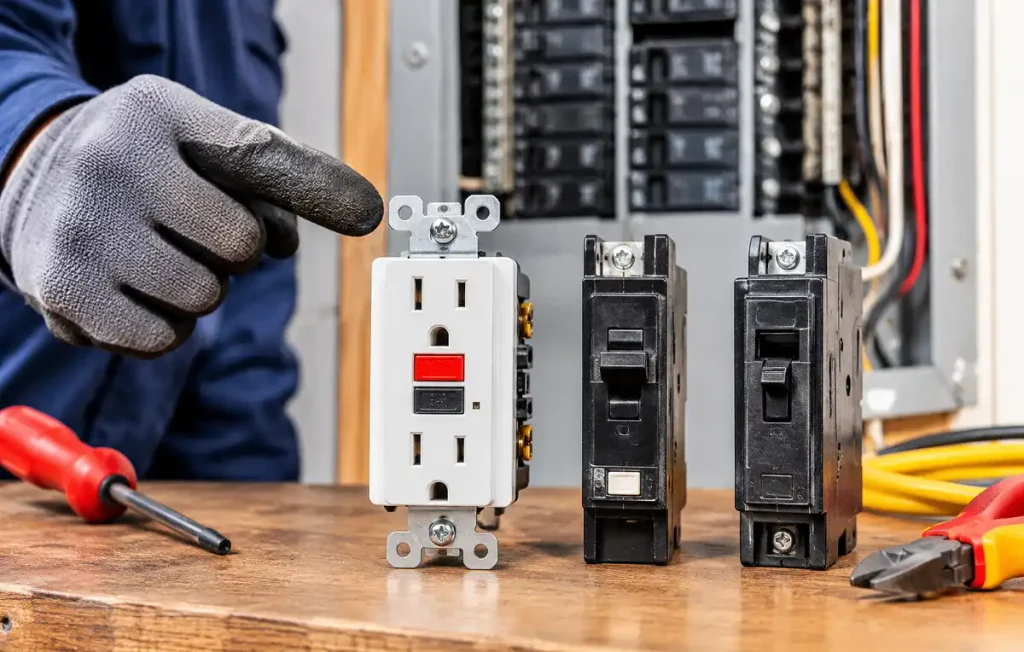
GFCIs and AFCIs solve different problems. A GFCI stops shock from ground faults. An AFCI (arc-fault circuit interrupter) stops fires caused by arcing, the sparking from damaged or loose wires. Many rooms now require both.
GFCI vs. AFCI Comparison
| Feature | GFCI | AFCI |
|---|---|---|
| Protects against | Electric shock and electrocution | Electrical fires from arcing |
| Detects | Current imbalance of about 5 mA | Arc signatures on the circuit |
| NEC section | 210.8 | 210.12 |
| Required in | Wet and damp areas, kitchens, baths, garages, outdoors, basements, laundry | Bedrooms, living rooms, family rooms, dining rooms, hallways, closets, kitchens, laundry |
| Both required | Kitchens and laundry areas | Kitchens and laundry areas |
| Device options | Receptacle, breaker, portable | Breaker, outlet-branch-circuit (OBC) receptacle |
| Combination option | Dual-function AFCI/GFCI breaker or receptacle | Same |
Kitchens and laundry rooms are where both rules overlap. A dual-function breaker handles both in one device. That keeps panels cleaner and simplifies troubleshooting.
A GFCI protected Birmingham AL kitchen remodel will almost always use dual-function protection on the countertop circuits.
Older Birmingham Homes: Two-Prong Outlets and GFCI Upgrades
Our certified electricians frequently see this in older Birmingham homes: two-prong outlets on circuits with no ground wire. Homes in Bessemer, Fairfield, Ensley and the first-ring suburbs often date to the 1920s through 1960s. Many were wired with knob-and-tube or early cloth-insulated cable.
The NEC Allowance for Ungrounded Circuits
NEC 406.4(D)(2) allows a GFCI to replace a two-prong outlet on an ungrounded circuit. The GFCI provides shock protection without a ground wire. The outlet must carry two labels: “No Equipment Ground” and “GFCI Protected.”
This is a legal, affordable safety step. It has limits:
- Surge protectors won’t work properly without a true ground.
- Computers and sensitive electronics still lack equipment grounding.
- Damaged insulation behind the wall isn’t fixed by a new device.
- AFCI protection may still be missing in bedrooms and living areas.
Repair vs. Replace vs. Rewire
| Condition | Best Approach | Typical Cost Range | Long-Term Value |
|---|---|---|---|
| Single worn GFCI, wiring sound | Replace the device | $120 to $250 | High |
| Two-prong outlets, wiring sound | GFCI with “No Equipment Ground” label | $150 to $300 per circuit | Good short-term |
| Ungrounded circuits in kitchen or bath | Run new grounded circuit | $400 to $1,200 per circuit | High |
| Brittle cloth wiring or knob-and-tube | Partial or whole-home rewire | $8,000 to $25,000+ | Highest |
A GFCI is a safety patch, not a wiring repair. When insulation crumbles at the box or multiple circuits are ungrounded, whole-house or room-by-room home rewiring adds grounding, capacity and modern protection in one project.
Getting older GFCI protected Birmingham AL homes to current standards usually happens in stages. Start with kitchens, baths and outdoor outlets, then plan the rest.
Aluminum Wiring in House Birmingham AL: What It Means for Your Safety, Comfort, and Repair Budget
How to Test and Reset a GFCI Outlet
Every GFCI should be tested once a month. Manufacturers and the NEC listing standard (UL 943) both call for regular testing. Since 2015, new GFCIs include self-test features, but the manual test still confirms the device actually cuts power.
Monthly Testing Steps
- Plug in a lamp or a plug-in GFCI tester and turn it on.
- Press the TEST button. You should hear a click, and the lamp should go off.
- Check downstream outlets on the same circuit. They should be dead too.
- Press the RESET button firmly until it clicks and stays in.
- Confirm power returns to the lamp and downstream outlets.
- Replace the GFCI if it fails to trip, fails to reset or shows a red or blinking status light.
How to Reset a Tripped GFCI
- Unplug everything on the affected outlets.
- Find the GFCI device. Check bathrooms, garages, kitchens and the panel for a GFCI breaker.
- Press RESET on the receptacle, or switch the GFCI breaker fully OFF and then ON.
- Plug devices back in one at a time to spot a faulty appliance.
A GFCI protected branch circuit can confuse homeowners here. A dead porch outlet in Pelham often traces back to a GFCI in the garage or master bath.
When a Tripping GFCI Signals a Wiring Problem
A GFCI that trips is reporting a leak. Sometimes the cause is harmless moisture. Sometimes it’s a damaged cable, a failing appliance or a wiring fault that needs a licensed electrician.
GFCI Troubleshooting Table
| Symptom | Likely Cause | What You Can Do | Call an Electrician? |
|---|---|---|---|
| Trips after rain or storms | Moisture in outdoor box | Install in-use (bubble) cover, let box dry | Yes, if it continues after drying |
| Trips when one appliance runs | Faulty appliance or cord | Test appliance on another GFCI | No, replace or repair the appliance |
| Trips with nothing plugged in | Wiring fault, moisture or failed device | Unplug everything, try reset | Yes |
| Won’t reset at all | Active ground fault, no power, reversed LINE/LOAD, failed device | Check breaker, try reset again | Yes |
| Trips when HVAC condenser starts | Inverter leakage or equipment fault | Note the timing, don’t bypass | Yes, coordinate with HVAC tech |
| Buttons won’t click or feel loose | Worn internal mechanism | Stop using it | Yes, replace device |
| Warm, buzzing or scorched face | Loose connection or overload | Turn off breaker immediately | Yes, right away |
| Several rooms dead at once | Tripped upstream GFCI | Find and reset the first GFCI | Only if reset fails |
| Trips every few days for no clear reason | Leakage in shared neutral or damaged cable | Track patterns | Yes |
Nuisance Trip or Real Fault?
Signs it’s a nuisance trip:
- Happens only during heavy humidity
- Stops once an old appliance is unplugged
- Follows a specific tool, like a pressure washer or shop vac
Signs it’s a wiring problem:
- Trips with nothing plugged in
- Won’t reset even after drying out
- Shows heat, buzzing or scorch marks
- Started after a remodel, storm or rodent activity in the attic or crawl space
Never replace a tripping GFCI with a standard outlet to stop the trips. That removes protection from the exact circuit telling you something is wrong. For outlets that won’t reset or trip constantly, GFCI outlet repair from a licensed local electrician traces the root cause instead of swapping parts.
GFCI Maintenance Checklist for Birmingham Homeowners
A few minutes each month keeps a home GFCI protected Birmingham AL weather will test every season. Use this checklist:
- Test every GFCI monthly with the TEST and RESET buttons.
- Check outdoor covers each spring before storm season. Cracked or missing in-use covers let water in.
- Inspect garage and basement outlets for rust or corrosion every fall.
- Label downstream outlets “GFCI Protected” so everyone knows where the reset lives.
- Replace any GFCI over 10 years old, especially outdoors or in damp spaces.
- Keep GFCIs accessible. Don’t block them with refrigerators, freezers or storage shelves.
- Watch for status lights. Red or blinking indicators on self-test models mean the device has failed.
- Retest after storms or power surges, since lightning can damage GFCI electronics.
- Schedule a professional check before selling, buying or remodeling.
Hiring a Licensed Electrician for GFCI Work in Birmingham
GFCI work looks simple until LINE and LOAD terminals, shared neutrals and old wiring enter the picture. In Alabama, electrical contractors must hold a license through the Alabama Electrical Contractors Board. Ask for the license number and proof of insurance before work starts, then verify the license on the Board’s public lookup.
Questions to Ask Before Work Begins
- Ask which NEC edition your city or county enforces.
- Confirm whether a permit is needed for new circuits, panel work or HVAC disconnects.
- Request a written scope listing each GFCI location and device type.
- Ask about panel compatibility for GFCI or dual-function breakers.
- Verify the license with the Alabama Electrical Contractors Board.
BirminghamALElectrician.com is a referral service. One call connects you with an independent, licensed electrician who serves your part of Birmingham, Bessemer, Fairfield, Pelham, Alabaster, Helena, Chelsea or nearby communities. Pricing and scheduling are agreed directly with the electrician you choose.
Ceiling Fan Repair Birmingham AL: How a Failing Fan Affects Your Wiring, Comfort and Energy Bill
Essential Questions Explained
Where are GFCI protected outlets required in a Birmingham home?
Under the 2023 NEC, GFCI protected outlets are required in bathrooms, kitchens, garages, outdoors, basements, crawl spaces, laundry areas, boathouses and within 6 feet of sinks, tubs and showers. Local adoption determines which edition applies to your address.
Do I have to upgrade my old outlets to GFCI?
Not automatically. When you replace a receptacle in a GFCI-required location, the new one must meet the current GFCI protected outlet code. Remodels also trigger updated rules for the affected rooms.
Can one GFCI protect several outlets?
Yes. A GFCI protected branch circuit uses one GFCI breaker or one GFCI receptacle wired through its LOAD terminals to protect every downstream outlet.
Why does my outdoor GFCI trip after it rains?
Moisture is entering the box. An in-use cover and a weather-resistant GFCI usually solve it. If tripping continues after the box dries, a wiring fault may be present.
Does my AC condenser need GFCI protection now?
It may. The 2023 NEC exception for listed HVAC equipment expired September 1, 2026. Ask your electrician and HVAC contractor which code edition your jurisdiction enforces.
How long does a GFCI outlet last?
Plan on about 10 years indoors. Outdoor and damp-location units often wear out sooner in Alabama humidity.
Is a GFCI the same as an AFCI?
No. GFCIs prevent shock. AFCIs prevent arc-related fires. Kitchens and laundry areas need both, often through a dual-function device.
Keep Your Home Protected Where Water and Power Meet
GFCI protection is a low-cost device that prevents a high-cost tragedy. The 2023 NEC widened the list of required locations, and the expired HVAC exception adds new questions for outdoor equipment. Older homes in Bessemer and Fairfield face different gaps than newer builds in Alabaster or Chelsea, but the first step is the same. A GFCI protected Birmingham AL home starts with knowing which outlets are covered and which ones aren’t.
Walk your house this weekend, press TEST on every GFCI, and call to connect with a licensed local electrician for any unit that won’t trip, won’t reset or keeps tripping.