Quick answer: A fuse box and a breaker panel do the same job: they cut power to a circuit when too much current flows. A fuse does it with a metal strip that melts and must be replaced, while a breaker trips a switch that can be reset. Fuses still work when properly sized, but most fuse boxes are decades old, have limited capacity and are easy to misuse, which is why many homeowners replace them with a modern breaker panel.
If you have ever opened a basement door in an older Birmingham house and found a gray box of screw-in fuses, you are not alone. Plenty of homes built in the early and mid 1900s, especially in neighborhoods like Norwood, West End and Crestwood, still have fuse boxes or had them until recently.
People often ask whether a fuse box is dangerous by itself. The short answer is that the fuse is not the problem. The age of the equipment, the load it now carries and the way fuses get swapped are.
How a fuse works
Inside each fuse is a thin metal link sized for a specific current. When a circuit draws more than that for long enough, the link heats up and melts, opening the circuit. The fuse is then spent and has to be replaced with a new one of the same rating.
Homes with fuses usually have two kinds: screw-in plug fuses for general lighting and outlet circuits, and cartridge fuses in pull-out blocks for the main and large appliance circuits.
Fuses respond quickly and have no moving parts, which is why they are still used in some modern equipment. In a house, though, their weakness is human, not technical.
How a circuit breaker works
A breaker is a switch with a built-in trip mechanism. Overcurrent heats a bimetal strip or triggers a magnetic element, and the breaker snaps to the off or tripped position. Once the cause is fixed, you reset it by pushing the handle fully off and back on.
Modern panels also accept breakers with extra protection: AFCI breakers that detect dangerous arcing and GFCI breakers that detect current leaking to ground. Current code calls for these on many circuits. Fuse boxes cannot provide them at the panel. Learn more in what AFCI protection is.
Side by side
- Resetting: a fuse is replaced; a breaker is reset.
- Capacity: fuse boxes were often installed with 60-amp or smaller service; breaker panels commonly handle much more.
- Circuit spaces: fuse boxes have few circuits; breaker panels have room for more.
- Added protection: breaker panels can host AFCI and GFCI breakers; fuse boxes cannot.
- Tampering risk: a fuse of the wrong size fits the same socket unless rejection adapters are used; breakers are sized to the panel.
- Insurance and resale: some insurers and buyers ask questions about fuse boxes. Check with your insurer.
Why old fuse boxes cause trouble
The most common hazard is oversizing. When a 15-amp fuse keeps blowing, someone screws in a 20 or 30 in its place. The fuse stops blowing, but the wire behind it was never meant for that current, so it can overheat inside the walls. Pennies behind fuses and other makeshift fixes are an even worse version of the same thing.
Beyond that, fuse boxes in Birmingham's older homes are usually decades old. Terminals loosen, insulation near the box can become brittle, and the service often cannot support central air, a modern kitchen and today's electronics. Frequent blown fuses are the same warning sign as a circuit breaker that keeps tripping: a circuit is overloaded or has a fault.
Do not upsize fuses. Always replace a blown fuse with one of the same amperage printed on the old one. If a correct fuse keeps blowing, stop replacing it and have the circuit checked.
What fuse box replacement involves
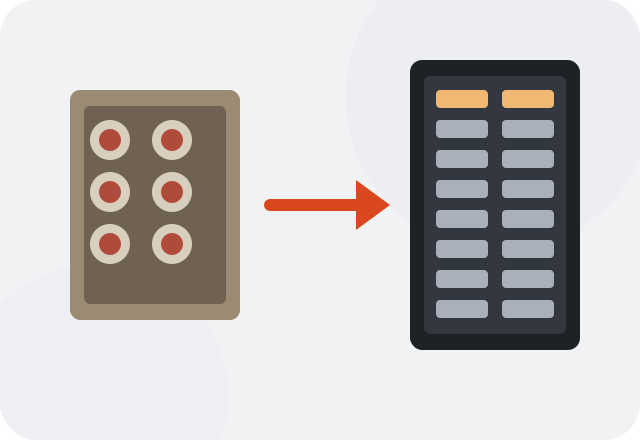
Replacing a fuse box usually means installing a new breaker panel and, in many homes, upgrading the service at the same time. It is a permitted job that includes an inspection and coordination with your electric utility.
Evaluation
An electrician checks the service, grounding and the condition of the existing wiring, since old fuse boxes often feed old circuits.
Plan the panel
Service size and the number of circuit spaces are chosen based on a load calculation and future plans.
Permit and utility scheduling
The permit is pulled, and the utility is scheduled to disconnect and reconnect service.
Install and transfer circuits
The new panel goes in, circuits are moved and labeled, and required protection is added.
Inspection
The local inspector approves the work before permanent power is restored.
Cost factors include whether the service is upgraded, the meter base and mast condition, grounding corrections, panel location and how many old circuits need attention. Some homes also need partial or full home rewiring once the old wiring is exposed. The electrical panel upgrade guide covers the process in more detail.
Safety while you still have fuses
Keep spare fuses of the correct sizes on hand, labeled by circuit. Change a fuse only with dry hands, standing on a dry surface, with the circuit's load unplugged or switched off first. Never touch the socket, and never use a coin, foil or wire in place of a fuse. If the box is warm, smells burnt, crackles or shows scorch marks, leave it alone and call an electrician; smoke or flames mean get out and call 911.
Key takeaways
- Fuses and breakers both protect wiring from overcurrent; a fuse melts and is replaced, a breaker trips and is reset.
- The main risks with fuse boxes are age, limited capacity and the temptation to install oversized fuses.
- Breaker panels can add AFCI and GFCI protection that fuse boxes cannot.
- Fuse box replacement is a permitted job that often includes a service upgrade and a look at older wiring.
Frequently asked questions
Existing fuse boxes are not automatically illegal, and many are still in service. New installations and major work must meet current code, which generally leads to a breaker panel. Insurance companies and buyers may have their own concerns, so check with your insurer.
Some insurers view old fuse boxes as a higher risk because of their age, limited capacity and the chance of oversized fuses. Policies vary, so ask your insurer what they require. An electrician's written evaluation may help answer their questions.
No. The fuse rating is matched to the wire on that circuit. A larger fuse lets the wire carry more current than it can safely handle, which can overheat it inside the walls. If the correct fuse keeps blowing, the circuit needs attention.
Type S fuses use adapters that screw into the socket and only accept a fuse of a specific rating. Once installed, they make it much harder to put an oversized fuse in the wrong socket. An electrician can tell you whether they make sense as a short-term safety step.
Not necessarily. Many homes keep sound existing wiring on the new panel. But fuse boxes often serve older circuits, so the electrician will look at wire condition and may recommend replacing sections that are brittle, ungrounded or overloaded.
Look at the main electrical box, typically in a basement, utility room, hallway or on an exterior wall, without removing any covers. Round screw-in fuses or pull-out blocks mean fuses; rows of switch handles mean breakers. Some homes have a breaker panel plus an older fuse subpanel elsewhere.