
GFCI Protection Birmingham AL: What the 2026 Code, Humid Summers, and Older Wiring Mean for Your Home
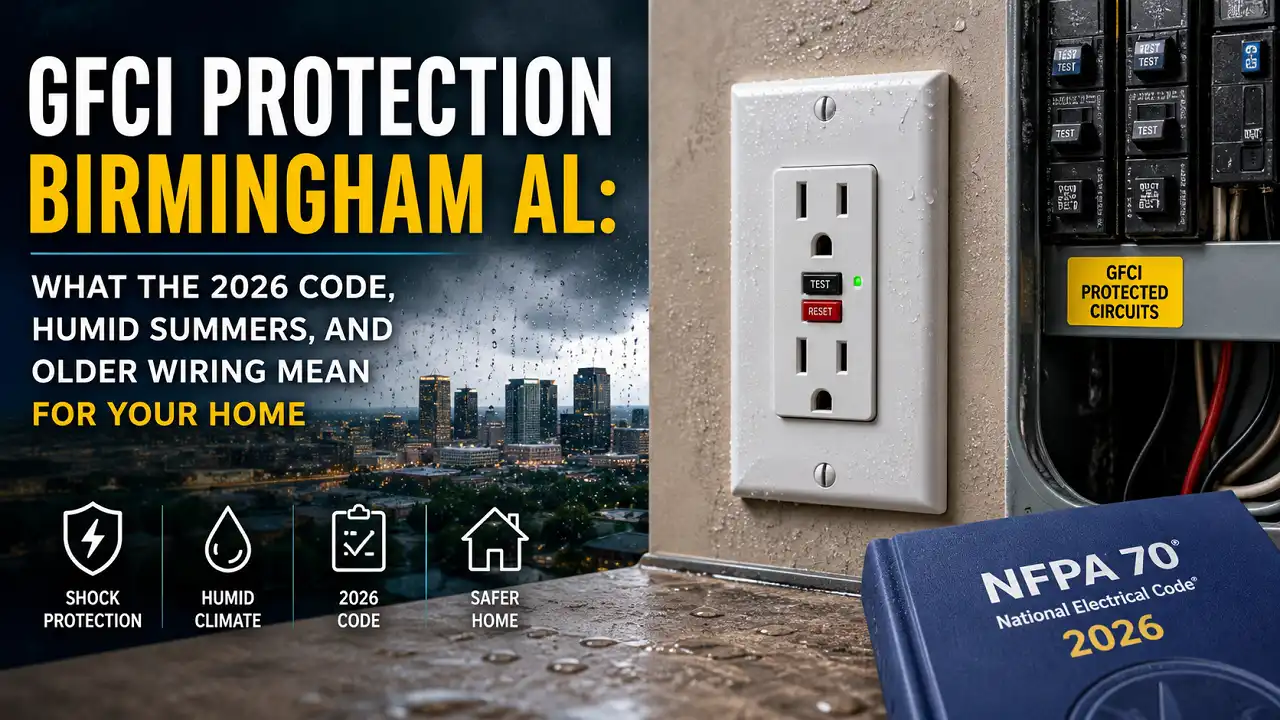
Water and electricity meet in more places than most homeowners realize: the bathroom sink, the kitchen counter, the crawl space, and even the outdoor AC condenser humming beside your patio. GFCI protection Birmingham AL homeowners rely on is the device that cuts power in a fraction of a second when current leaks through water or a person. The so what is simple. A missing, worn, or bypassed GFCI turns an ordinary wet area into a serious shock hazard, and central Alabama’s humidity wears these devices out faster than many people expect.
Key Takeaways
- GFCI devices trip at about 4 to 6 milliamps of leakage, fast enough to help prevent a fatal shock. Standard breakers do not offer this protection.
- The National Electrical Code now requires GFCI protection in bathrooms, kitchens, garages, basements, laundry areas, outdoors, and at many appliance and HVAC outlets.
- Test every GFCI monthly. Humidity, storms, and age can kill protection while the outlet still supplies power.
What Is GFCI Protection and How Does It Work?
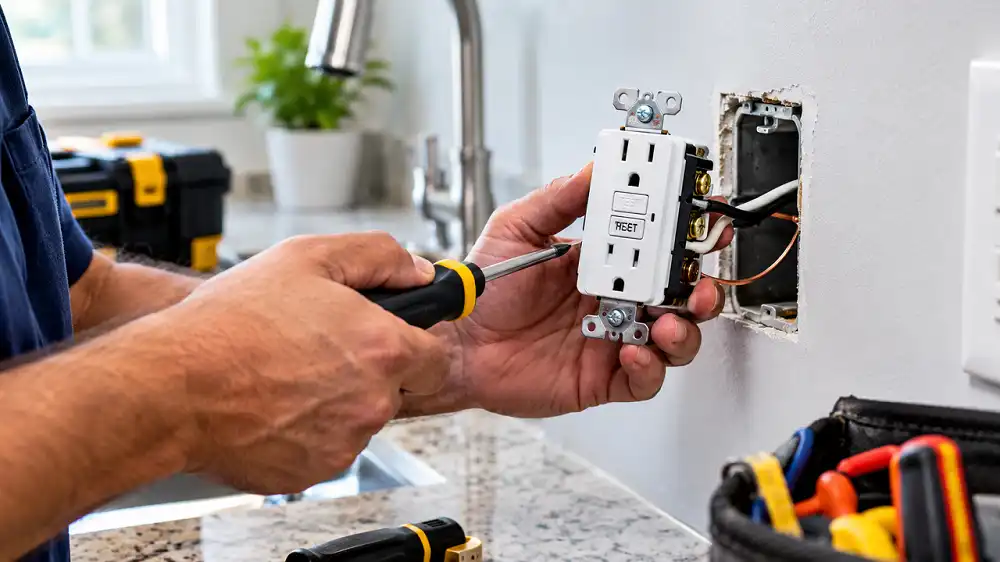
GFCI protection is shock protection. A ground fault circuit interrupter (GFCI) watches the current flowing out on the hot wire and back on the neutral wire. Those two numbers should match.
When they don’t, some current is escaping. It may be moving through water, a damaged cord, or your body. The GFCI senses that imbalance and opens the circuit almost instantly.
| Spec | What It Means for You |
|---|---|
| Trip threshold | About 4 to 6 milliamps (mA) of imbalance for Class A devices |
| Trip speed | Roughly 1/40 of a second at higher leakage levels |
| What it protects | People from shock and electrocution |
| What it does not protect | Wiring from overloads or short circuits (a standard breaker does that) |
| Self-test feature | Required on devices made since 2015; warns or locks out when protection fails |
For scale, about 100 mA across the heart can be fatal. A GFCI reacts at a tiny fraction of that level. Speed and sensitivity are the whole point.
On recent service calls across Jefferson and Shelby counties, the most common misunderstanding we hear is “my breaker protects me.” It doesn’t. A 20-amp breaker waits for 20 amps before it acts, and that is far too late for a person. Understanding the difference is the first step in getting GFCI protection Birmingham AL homes actually need.
GFCI Outlet vs. GFCI Breaker: Which Fits Your Home?
Both options provide the same protection. The difference is location. A GFCI outlet sits at the receptacle.
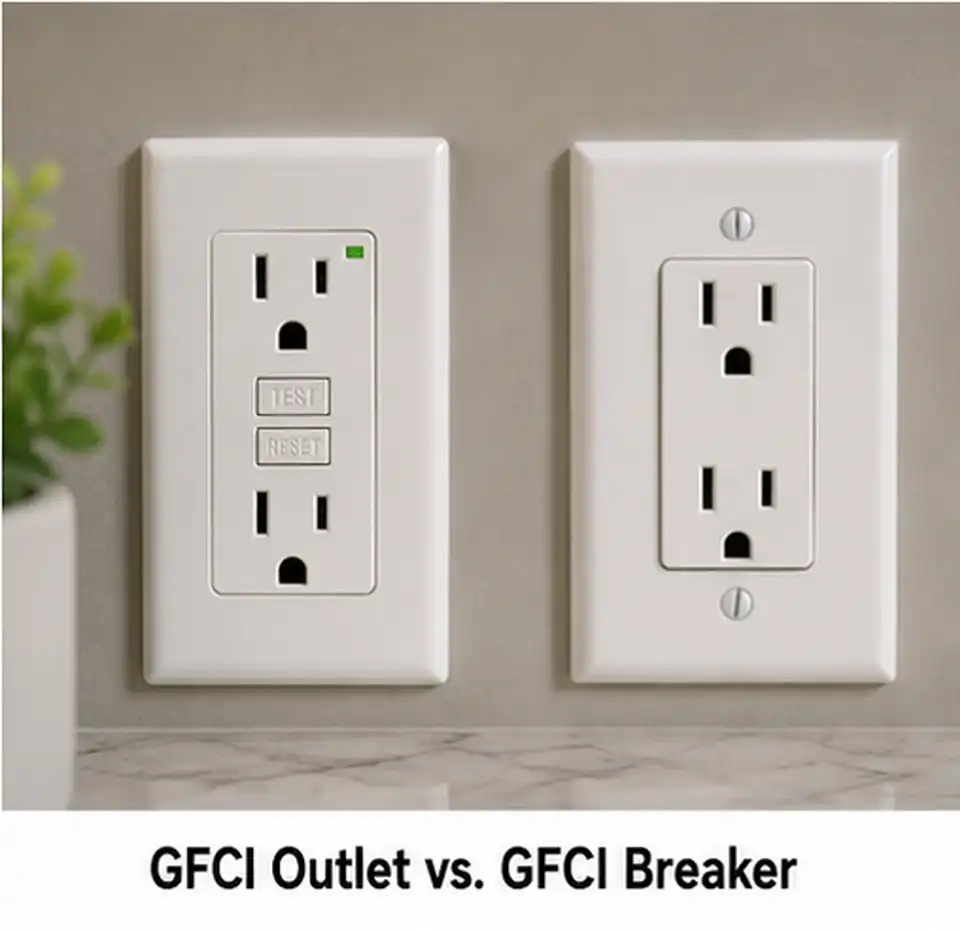
A GFCI breaker sits in your electrical panel and protects the entire circuit.
| Feature | GFCI Outlet | GFCI Breaker |
|---|---|---|
| Location | At the receptacle | In the panel |
| Coverage | That outlet plus any wired “downstream” | The entire circuit |
| Reset access | Right where you use it | Walk to the panel |
| Typical part cost | $15 to $40 | $40 to $120 |
| Best for | Bathrooms, kitchens, single outdoor outlets | Hard-to-reach outlets, hardwired equipment, multiple wet areas on one circuit |
| Panel compatibility | Works with any panel | Must be listed for your panel brand |
| Hardwired appliances | Not possible | Yes (dishwashers, pumps, HVAC disconnects) |
Pros and Cons at a Glance
GFCI outlet pros
- Easy reset right at the point of use
- Lower part cost
- Works in any home, including older panels
GFCI outlet cons
- Downstream outlets lose power with no obvious cause
- Bulkier device; tight in shallow old boxes
- Exposed to moisture in outdoor boxes
GFCI breaker pros
- Protects hardwired loads and whole circuits
- Stays dry and protected inside the panel
- One device covers several outlets
GFCI breaker cons
- Reset requires a trip to the panel
- Higher cost per device
- Not available for some obsolete panels
That last point matters in older homes. Some legacy panels, including certain Federal Pacific and Zinsco models, have no current GFCI breakers available. If your panel is full, outdated, or out of production, an electrical panel upgrade for your Birmingham home often becomes the cleanest path to modern protection. A new panel also gives you room for AFCI and dual-function breakers in one step.
Next step: open your panel door (not the cover) and look for breakers with a Test button. Those are your existing GFCI or AFCI breakers.
Check Also: Ceiling Fan Repair Birmingham AL: How a Failing Fan Affects Your Wiring, Comfort and Energy Bill
Where the 2026 NEC Requires GFCI Protection
GFCI requirements expand with almost every code cycle. The 2026 edition of the NFPA 70, National Electrical Code is the current national model code, and it carries forward the broad dwelling-unit list built up over the last several editions. The NFPA itself notes that many states and cities enforce older editions, so local adoption decides what your inspector checks.
| Location | GFCI Required? | Notes from the Field |
|---|---|---|
| Bathrooms | Yes, all receptacles | Most common missing GFCI we find in pre-1975 homes |
| Kitchens | Yes, all receptacles (not just countertops) | Includes refrigerator outlets under newer editions |
| Sinks (any room) | Within 6 feet of the bowl edge | Wet bars, laundry sinks, utility sinks |
| Bathtubs and showers | Within 6 feet | Applies outside the bathroom too |
| Garages and accessory buildings | Yes | Includes freezers and garage door openers |
| Outdoors | Yes | Porches, decks, patios, soffit outlets |
| Basements | Yes, finished and unfinished | Sump pump circuits included |
| Crawl spaces | Yes, at or below grade | Dehumidifiers and lighting outlets |
| Laundry areas | Yes | Includes many 240-volt dryer outlets |
| Indoor damp or wet locations | Yes | Mudrooms, utility rooms |
| Boathouses | Yes | Lay Lake and Logan Martin docks |
| Specific appliances | Yes | Dishwashers, ranges, wall ovens, dryers, microwaves (per recent editions) |
| Outdoor HVAC equipment | Yes, with edition-specific exceptions | See HVAC section below |
| Pools, spas, hot tubs | Yes | Governed by NEC Article 680 |
The HVAC Connection: Why Your AC Condenser Now Needs GFCI
Outdoor HVAC equipment is the newest and most debated GFCI requirement. The 2020 NEC extended GFCI protection to outdoor outlets, which pulled in hardwired AC condensers and heat pumps.
Problem: many inverter-driven, variable-speed compressors leak small amounts of current by design. That caused nuisance tripping. On a 97-degree July afternoon in Hoover or Helena, a tripped condenser means a hot house fast.
The 2023 NEC answered with a temporary exception for listed HVAC equipment, written to expire on September 1, 2026. Equipment makers have been updating designs to work with GFCI devices. The practical result: rules for your condenser depend on your local code edition and your equipment.
| HVAC Component | GFCI Concern | What We Recommend |
|---|---|---|
| Outdoor condenser / heat pump | Nuisance trips with older inverter units | Confirm local rule; use equipment listed for GFCI compatibility |
| Mini-split outdoor unit | Same leakage issue | Ask installer about manufacturer GFCI guidance |
| Condensate pump (basement or crawl) | Wet location | GFCI required; test monthly |
| Crawl space dehumidifier | Damp location | GFCI required; check for trips after storms |
| Service receptacle near condenser | Outdoor outlet | GFCI and in-use cover required |
If you’ve spent a summer in Alabama, you know a dead condenser isn’t a minor inconvenience. Before replacing or adding an outdoor unit, ask both your HVAC contractor and electrician how they’ll handle GFCI protection Birmingham AL inspectors expect on that circuit.
Why Birmingham’s Climate Wears Out GFCI Devices Faster
Humidity shortens GFCI life. Central Alabama sees long stretches of 70 to 90 percent relative humidity from May through September. Moisture gets into outdoor boxes, crawl spaces, and garages.
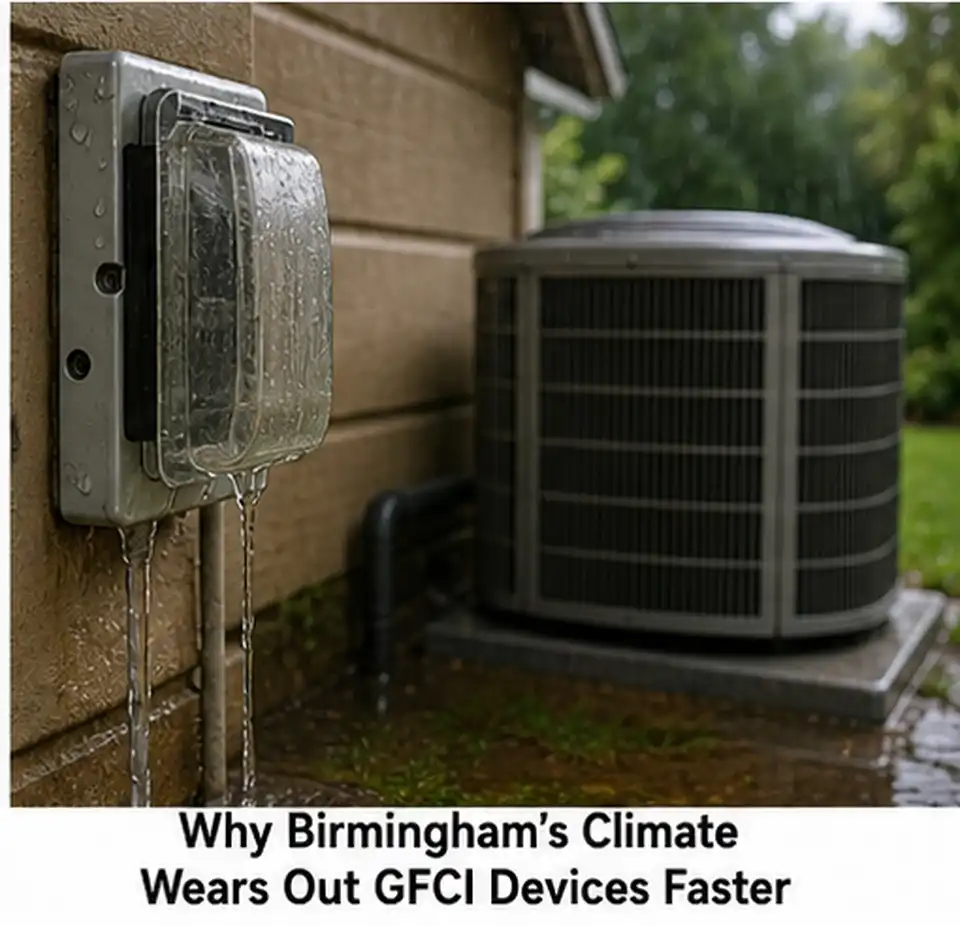
That moisture causes three problems:
- Corrosion on terminals and internal contacts
- Leakage paths that trigger repeated trips
- Component breakdown that can disable protection silently
Storms add a fourth stressor. Central Alabama’s spring and fall severe weather brings frequent lightning. Voltage surges damage the sensing electronics inside GFCIs. A GFCI that survived the storm may no longer protect you.
| Stress Factor | Effect on GFCI | Where We See It Most |
|---|---|---|
| High humidity | Corrosion, nuisance trips | Crawl spaces, garages, porches |
| Driving rain | Water in boxes | Outdoor outlets without in-use covers |
| Lightning surges | Damaged sensing circuits | Homes without whole-home surge devices |
| Heat | Faster component aging | Attic-adjacent garages, west-facing exteriors |
| Winter temperature drops | Condensation inside boxes | Unheated garages and sheds |
Our local service partners frequently replace outdoor GFCIs in Pelham and Chelsea homes that are under ten years old. The cause is usually a missing weather-resistant (WR) rating or a flat cover that only seals when nothing is plugged in.
The fix is layered protection. Pairing GFCIs with whole-home surge protection for storm-prone Birmingham homes helps shield the electronics inside them. For GFCI protection Birmingham AL weather won’t defeat, use WR-rated outlets and bubble-style in-use covers outdoors.
Next step: walk your exterior after the next rain. Check each outdoor outlet for a WR mark on the face and a cover that closes over a plugged-in cord.
GFCI Protection in Older Birmingham Homes
Home age predicts GFCI coverage. Requirements arrived in stages: outdoors in 1971, bathrooms in 1975, garages in 1978, kitchen countertops in 1987, and basements and crawl spaces around 1990. Newer editions keep adding locations.
Our certified electricians frequently see the gap in older Birmingham homes. Neighborhoods near downtown, along with older housing in Fairfield and Bessemer, often have two-prong outlets, small panels, and decades of patchwork repairs.
| Construction Era | Typical GFCI Status | Common Findings | Recommended Action |
|---|---|---|---|
| Pre-1975 | Little to none | Ungrounded two-wire circuits, no bath GFCIs | Add GFCIs in all wet areas; evaluate wiring |
| 1975 to 1990 | Baths and maybe outdoors | Original GFCIs past their service life | Replace aging devices; add kitchen and garage |
| 1990 to 2000 | Baths, kitchens, garages, outdoors | Early devices with no self-test | Upgrade to self-testing GFCIs |
| 2000 to 2015 | Most wet areas covered | Missing laundry and dishwasher protection | Fill code-cycle gaps during remodels |
| Post-2015 | Broad coverage, self-testing | Nuisance trips on appliances, outdoor box moisture | Monthly testing; WR outlets outdoors |
Can You Add GFCI to Ungrounded Outlets?
Yes. The NEC permits a GFCI outlet as a replacement for a two-prong receptacle where no ground exists. The outlet must carry a “No Equipment Ground” label. It protects people from shock. It does not provide a true equipment ground for surge protectors or sensitive electronics.
Newer subdivisions in Alabaster and Helena have different issues. Builder-grade devices fail early, and one GFCI may feed outlets in three different rooms. A professional electrical inspection for your Birmingham-area home maps which GFCIs protect which outlets and flags code gaps before they become hazards. Getting GFCI protection Birmingham AL inspectors approve starts with that map.
Before any work begins, confirm your electrician’s license with the Alabama Electrical Contractors Board. The state license check is the same in every county.
How to Test a GFCI Outlet
Testing takes under a minute. Manufacturers recommend monthly tests.

Here’s the process:
- Plug in a lamp or nightlight and turn it on.
- Press the Test button. The lamp should go dark and the Reset button should pop out.
- Press Reset. The lamp should come back on.
- Check downstream outlets on the same circuit; they should go dead during the test.
- Record failures. If the lamp stays on after Test, protection has failed.
- Stop using a failed outlet and call a licensed electrician.
For GFCI breakers, press the Test button on the breaker. The handle should move to the tripped position. Reset by pushing it fully off, then on.
Monthly GFCI Testing Checklist
| Location | Frequency | What to Check | Pass Result |
|---|---|---|---|
| Bathrooms | Monthly | Test/Reset response | Power cuts and restores |
| Kitchen counters | Monthly | All GFCIs and downstream outlets | All lose power on test |
| Garage | Monthly | Freezer outlet, opener outlet | Restores cleanly |
| Outdoor outlets | Monthly and after storms | Cover seal, WR marking, test | No moisture, clean trip |
| Basement / crawl space | Monthly | Sump and dehumidifier circuits | Restores; equipment restarts |
| Panel GFCI breakers | Quarterly | Breaker Test button | Handle trips |
| Pool / spa | Before each season and monthly in use | Equipment GFCI and disconnect | Trips and resets |
Write the date on a strip of painter’s tape inside the panel door. It keeps the routine honest.
Signs Your GFCI Needs Repair or Replacement
GFCIs wear out. Typical service life runs 10 to 15 years, often less in damp locations. Watch for these warning signs:
- Won’t reset after pressing the button
- Trips with nothing plugged in
- Doesn’t trip when you press Test
- Warm or discolored faceplate
- Buzzing, crackling, or a burning smell
- Red or flashing indicator light on self-testing models
- Loose plugs that fall out of the receptacle
- Trips during every rain (moisture in the box)
Common Causes of Repeated Tripping
- Moisture in an outdoor or garage box
- Failing appliance with internal leakage (old freezers, pressure washers, hair dryers)
- Too many outlets downstream adding cumulative leakage
- Damaged wiring inside walls
- Worn GFCI with weak internal parts
Never tape the button down or swap the GFCI for a standard outlet. The trip is usually the device doing its job.
Repair vs. Replace
| Situation | Repair | Replace | Why |
|---|---|---|---|
| Fails the Test button | ✓ | Internal protection has failed | |
| Over 10 years old | ✓ | Predates modern self-test standards | |
| Trips from one appliance only | ✓ | The appliance is the problem | |
| Moisture in outdoor box | ✓ | ✓ | Dry and reseal box; replace if corroded |
| Scorch marks or heat | ✓ | Fire risk; check wiring behind it | |
| Loose wire connection | ✓ | Retighten or replace terminals | |
| Damaged wiring behind outlet | ✓ | Wiring repair, then new device | |
| No WR rating outdoors | ✓ | Required for wet locations |
Scorched or warm outlets point to a wiring problem behind the device, not just a bad GFCI. Our network handles that through electrical outlet repair for damaged and scorched receptacles, which addresses the connections a new device alone won’t fix.
GFCI Cost Comparison: DIY vs. Licensed Electrician
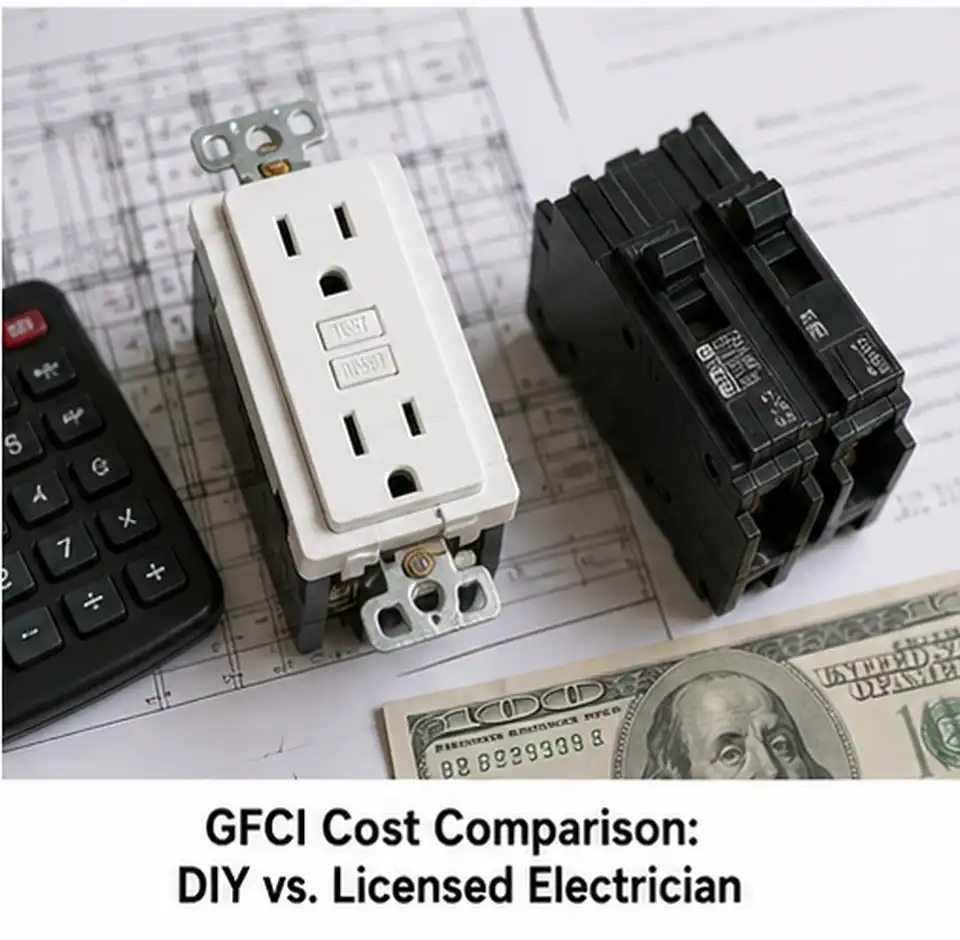
Professional installation costs more up front and less over time. The figures below are typical Birmingham-area ranges as of fall 2026. Actual quotes depend on access, box condition, wiring, and permit requirements.
| Job | DIY Parts Cost | Licensed Electrician (Installed) | Notes |
|---|---|---|---|
| Replace one GFCI outlet | $15 to $40 | $120 to $250 | Price drops per outlet when bundled |
| Add GFCIs to a full kitchen | $60 to $160 | $300 to $650 | Depends on circuit layout |
| GFCI breaker install | $40 to $120 | $150 to $350 | Must match panel brand |
| Dual-function (AFCI/GFCI) breaker | $50 to $130 | $175 to $375 | Common in remodels |
| Outdoor WR GFCI with in-use cover | $30 to $60 | $150 to $300 | New circuit costs more |
| Hot tub GFCI disconnect (50A) | $100 to $200 | $800 to $2,500 (full circuit) | Distance from panel drives price |
| Whole-home GFCI audit and upgrade | N/A | $500 to $1,500 | Older homes with many wet areas |
DIY Pros and Cons
Pros
- Lower upfront cost
- Simple like-for-like swaps are manageable for some homeowners
Cons
- Line and load terminals get reversed often, leaving outlets energized but unprotected
- No diagnosis of the underlying fault causing trips
- Shallow or crowded old boxes create loose connections
- New circuits and panel work usually need a permit in Jefferson and Shelby counties
A reversed line/load connection is the error we see most from DIY jobs. The outlet works. It just doesn’t protect anyone. For GFCI protection Birmingham AL families can trust, a licensed electrician verifies wiring with a GFCI tester, not just the Test button.
Next step: when comparing quotes, ask whether each price includes testing all downstream outlets and any required permit.
GFCI for Pools, Hot Tubs, Basements, and Outdoor Circuits
Pools and spas carry the highest shock risk in a home. NEC Article 680 covers them. Requirements include GFCI protection for pump motors, underwater lights over the low-voltage limit, and receptacles near the water, plus equipotential bonding of metal parts.
| Equipment | GFCI Requirement | Additional Requirements |
|---|---|---|
| Pool pump motor | Yes | Dedicated circuit, bonding |
| Underwater pool lights | Yes (line-voltage lights) | Listed fixtures, proper niche bonding |
| Receptacles near pools | Yes, within set distances | WR rating, in-use covers |
| Hot tub / spa | Yes | GFCI disconnect within sight, at least 5 feet from water |
| Dock and boat lift power | Yes | Lay Lake and Logan Martin docks need special attention |
| Landscape lighting transformer | Plugs into GFCI outlet | Outdoor-rated, in-use cover |
| Sump pump | Yes | Test after storms; consider alarm |
Hot tubs on decks across Pelham and Helena often run on undersized or aging circuits. We regularly find spa disconnects mounted too close to the water or missing GFCI protection entirely.
Basements and Crawl Spaces
Below-grade spaces stay damp year-round. Central Alabama’s clay soils hold water after heavy rain. Sump pumps, dehumidifiers, and freezers all sit in the same moist air.
Watch for one tradeoff. A GFCI-protected sump pump that trips during a storm stops pumping. Pair it with a high-water alarm or battery backup so you know right away. Planning basement electrical work with proper moisture protection balances code-required GFCI with equipment that has to keep running. That balance is the core of GFCI protection Birmingham AL basements need.
GFCI vs. AFCI: What’s the Difference?
GFCI protects people. AFCI protects the house. A GFCI detects current leaking to ground. An arc fault circuit interrupter (AFCI) detects dangerous arcing inside wiring that can start a fire.
| Feature | GFCI | AFCI |
|---|---|---|
| Protects against | Electric shock | Electrical fires |
| Detects | Current imbalance (leakage to ground) | Arcing signatures in wiring |
| Required in | Wet and damp areas, outdoors, specific appliances | Most living areas: bedrooms, living rooms, kitchens, laundry |
| Device options | Outlet or breaker | Breaker or outlet (outlet-branch type) |
| Combination option | Dual-function breaker or outlet provides both | Same |
Kitchens and laundry areas often need both. A dual-function breaker handles that in one panel slot.
FAQs
1. How long does a GFCI outlet last?
Most last 10 to 15 years. Outdoor, garage, and crawl space GFCIs in Birmingham’s humidity often fail sooner. Monthly testing is the only reliable check.
2. Why does one GFCI control outlets in other rooms?
A GFCI can protect downstream outlets on the same circuit. When it trips, those outlets go dead too. Check the nearest bathroom, garage, or exterior GFCI and press Reset once.
3. Does my refrigerator need GFCI protection?
Under recent NEC editions, kitchen and garage outlets generally require GFCI protection, which includes refrigerator and freezer outlets. Modern appliances rarely trip a healthy GFCI. Ask your electrician which code edition your city enforces.
4. Is GFCI protection required when I sell my home?
Alabama doesn’t require a retrofit at sale, but home inspectors flag missing GFCIs routinely. Buyers often request them as a repair item. Adding GFCI protection before listing avoids a last-minute negotiation.
5. Why does my outdoor GFCI trip every time it rains?
Water is getting into the box or into a plugged-in cord. Replace the flat cover with an in-use bubble cover and confirm the outlet is WR-rated. If tripping continues, have the box and wiring inspected.
6. Can a GFCI fail without tripping?
Yes. Older GFCIs can lose protection while still delivering power. Self-testing models made since 2015 signal or lock out when this happens. Press Test monthly to confirm.
7. Will GFCI protection trip my AC unit?
It can with some older inverter-driven condensers and heat pumps. Newer equipment is designed to work with GFCI protection. Coordinate your HVAC installer and electrician before replacing outdoor equipment.
8. Do I need a permit to add GFCI protection?
Replacing an outlet with a GFCI of the same rating usually doesn’t require one. New circuits, panel work, and hot tub wiring typically do. Requirements vary between Birmingham, Hoover, Pelham, and unincorporated Jefferson and Shelby County, so ask your electrician to confirm. Clear rules make GFCI protection Birmingham AL projects move faster.
Get Your Home’s GFCI Protection Checked
Missing or failed GFCIs are invisible until the moment they matter. At Birmingham AL Electrician, we connect homeowners across Birmingham, Fairfield, Bessemer, Pelham, Helena, Alabaster, Chelsea, and surrounding communities with independent, licensed local electricians who test, repair, and install GFCI protection the right way. One call puts you in touch with someone who serves your address.
Start with tonight’s quick win: test every GFCI in your home with a lamp. Then call us, describe what you found, and we’ll connect you with a local electrician who can close the gaps.