
Ceiling Fan Repair Birmingham AL: How a Failing Fan Affects Your Wiring, Comfort and Energy Bill
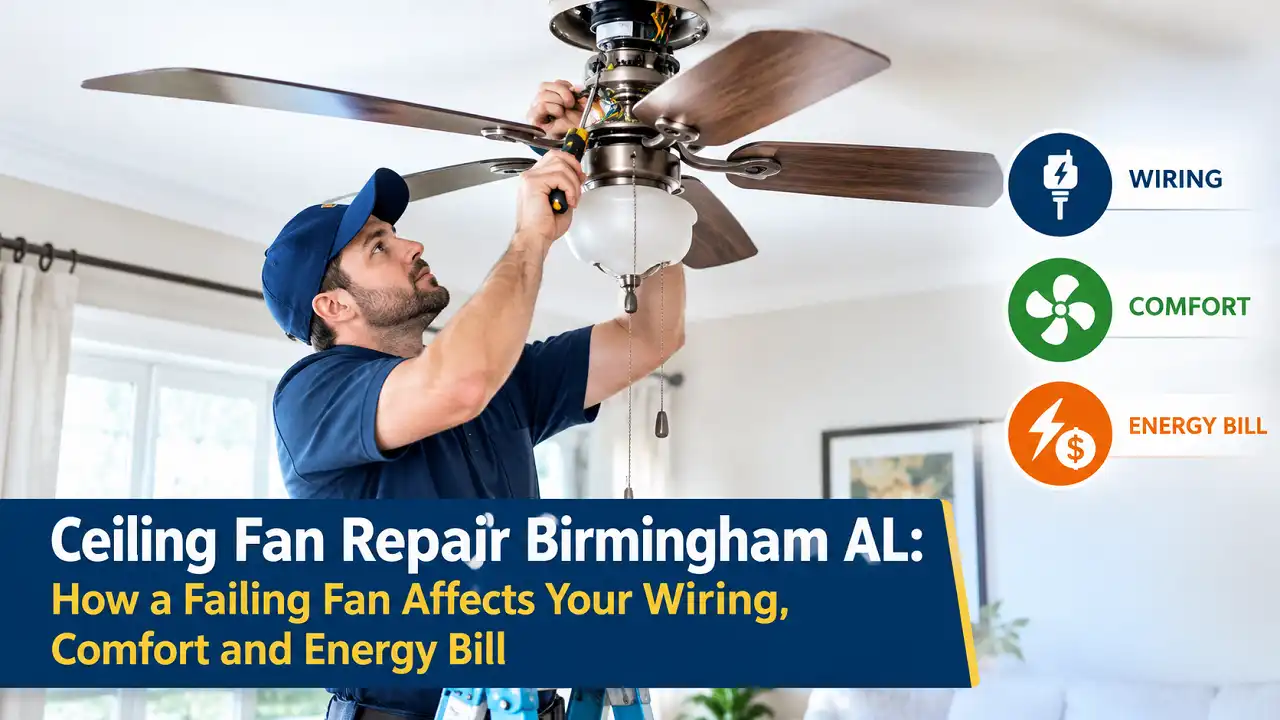
A ceiling fan that hums, wobbles or quits in the middle of an Alabama August is more than an annoyance. It can point to a failed capacitor, a loose mounting bracket or overheated canopy wiring sitting a few feet above your bed. For many households, ceiling fan repair Birmingham AL service is the fastest way to restore comfort without overworking the air conditioner. Catching the problem early often means a small repair instead of a new fan or a damaged ceiling.
Here is the so-what for homeowners. Birmingham summers run long and humid, and many local homes still have original light boxes that were never built to hold a spinning fan. When a fan fails, people tend to drop the thermostat, and the cooling bill goes up. This guide covers the most common symptoms, typical repair costs, when to replace instead of repair, the safety and code issues that matter, and how one call connects you with a licensed local electrician.
Key Takeaways
- Most fan failures are fixable. Capacitors, pull chain switches, remote receivers and loose connections cause the majority of problems, and typical repairs run about $50 to $350.
- Wobble is a safety issue, not a cosmetic one. A fan should hang from a fan-rated box anchored to framing. A moving canopy needs prompt attention.
- Verify before you hire. Alabama licenses electrical contractors through the Alabama Electrical Contractors Board, so confirm license and insurance before any work starts.
Why Ceiling Fans Matter So Much in Birmingham Homes

If you’ve spent a summer in Alabama, you know a working fan changes how a room feels. Moving air helps your body shed heat, so you feel cooler at the same thermostat setting. Energy guidance commonly cites raising the thermostat about 4°F with no loss of comfort when a fan is running. That small change adds up over a five-month cooling season.
Fans also help in winter. Running the fan clockwise on low pushes warm air from your heat pump back down from the ceiling. That matters in older Birmingham homes with tall ceilings in Crestwood, Avondale and Highland Park.
How a Fan Ties Into Your Electrical and HVAC Setup
A ceiling fan is a small motor on a branch circuit. It shares that circuit with lights and outlets, and it depends on sound connections, the right controls and a solid mount.
| System Link | What It Does | What Goes Wrong |
|---|---|---|
| Branch circuit | Feeds the fan and often the room’s outlets | Loose splices, overheating, tripped breakers |
| Wall control | Switches or sets fan speed | Standard dimmers make motors hum and overheat |
| Fan-rated box | Carries weight and motion | Light-only boxes loosen and let the fan sag |
| Thermostat and HVAC | Cools or heats the room | A dead fan pushes the AC to run longer |
| Remote receiver | Wireless speed and light control | Heat and storms damage receiver boards |
Common Ceiling Fan Problems and What They Mean
Most ceiling fan repair Birmingham AL calls start with one of seven symptoms. On recent service calls across Jefferson and Shelby counties, our local service partners see capacitor failures and worn pull chain switches more than anything else. Wobble and remote receiver issues come in close behind. The symptom usually tells you where to look first.
Symptom Diagnosis Table
| Symptom | Likely Cause | DIY Safe Check | Call an Electrician When |
|---|---|---|---|
| Wobbles at high speed | Unbalanced blades, loose blade irons, loose bracket | Tighten blade screws with power off | Canopy moves or the box is not fan-rated |
| Hums but won’t spin | Failed capacitor, wrong dimmer on the wall | Check if a standard dimmer controls the fan | Hum continues after the control is ruled out |
| Runs on one speed only | Bad capacitor or pull chain switch | Try every chain position | Chain is broken off or the switch is stuck |
| Light works, fan doesn’t | Switch, capacitor or motor winding | Confirm the fan switch or chain is on | Always, since this involves internal wiring |
| Remote stopped working | Dead batteries, receiver failure, frequency mismatch | Replace batteries, re-pair the remote | Receiver is hot, buzzing or failed after a storm |
| Light flickers | Loose socket, canopy wiring, incompatible bulb | Swap the bulb for a compatible LED | Flicker continues or you smell heat |
| Grinding or squealing | Worn motor bearings | None beyond cleaning | Noise is new and growing louder |
The Seven Failures We See Most Often
- Wobble. Usually blade balance or loose screws. If the canopy shifts, the problem is the mount.
- Humming. Often a failing capacitor or a light dimmer wired to a fan motor.
- Pull chain failure. Snapped chains or internal switch contacts that stop clicking through speeds.
- Capacitor failure. Weak capacitors cause slow starts, missing speeds or no spin at all.
- Motor and bearing wear. Grinding, overheating and slow speeds on older fans.
- Remote receiver failure. Heat buildup in the canopy and storm surges damage these boards.
- Canopy wiring faults. Loose wire nuts, cracked insulation and backstabbed connections.
When several fixtures or outlets act up together, the fan may not be the real problem. A loose neutral or a failing splice upstream can cause odd behavior across a whole room. In that case, our partners recommend electrical troubleshooting for Birmingham homes to trace the actual fault before anyone replaces parts.
Safe Troubleshooting Steps Before You Call
Some checks are safe for homeowners. Others belong to a licensed electrician. Never open the canopy, never touch wiring, and always kill power at the breaker before handling blades. A ladder and a live circuit are a bad combination.
What You Can Safely Check
- Confirm power. Check the wall switch and look for a tripped breaker at the panel. Reset a breaker once only.
- Test every control. Run each pull chain position and every remote button.
- Replace remote batteries and re-pair the remote using the manual.
- Check the wall control. If a standard light dimmer runs the fan, stop using it.
- Turn off the breaker, then tighten visible blade screws and blade iron screws.
- Try a balancing kit if the fan wobbles but the canopy stays still.
- Write down the pattern. Note when the problem happens and what else is running.
Warning Signs That Mean Stop and Call
- A burning or hot-plastic smell from the fan or switch
- Sparks, buzzing or crackling from the canopy
- A canopy that moves or a fan that sags
- A breaker that trips when the fan starts
- A switch plate that feels warm
- Lights that dim or flicker whenever the fan runs
If you see smoke or flames, get everyone out and call 911 first.
Ceiling Fan Repair Birmingham AL Cost Breakdown
Cost depends on the part, access and ceiling height. A pull chain swap costs far less than motor work, and a two-story foyer fan takes more time and equipment than a bedroom fan. Always ask for the price before work begins.
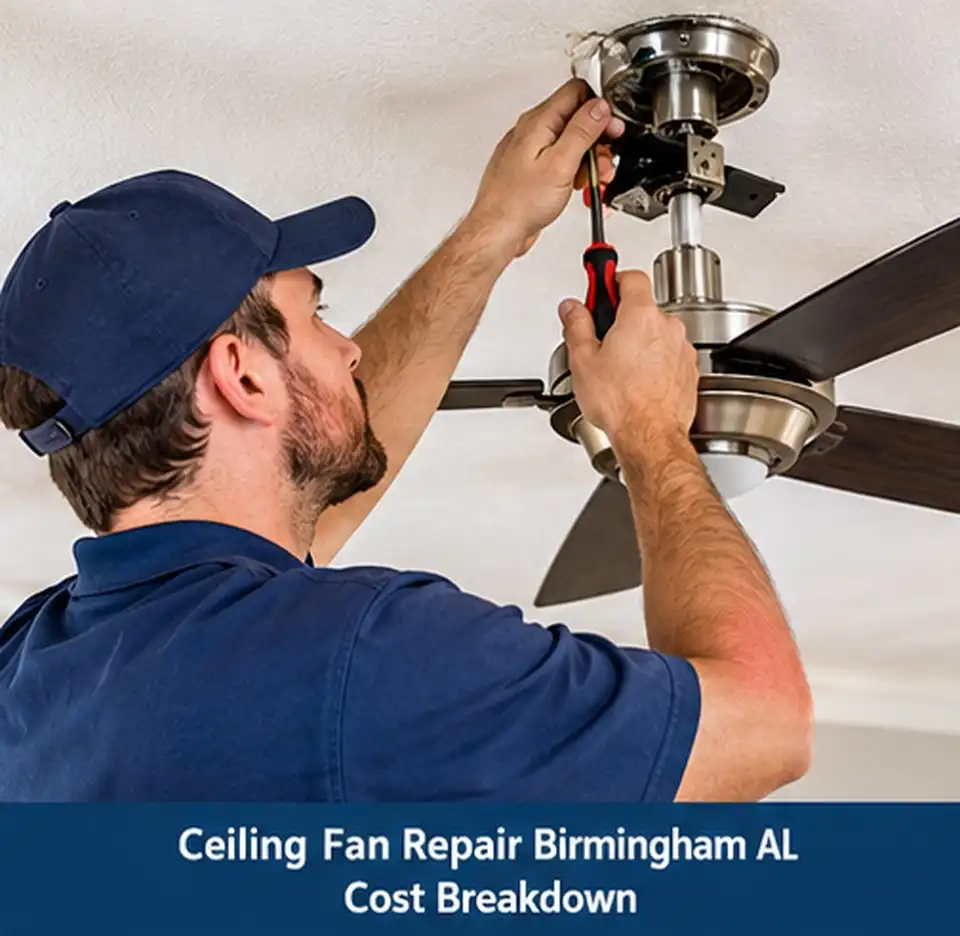
Typical Repair Costs in the Birmingham Area
| Repair Type | What’s Usually Included | Typical Range |
|---|---|---|
| Diagnostic visit | Testing motor, wiring, switch and controls | $50 to $100 |
| Pull chain or switch repair | Chain and internal switch replacement | $50 to $150 |
| Capacitor replacement | Matched capacitor and speed testing | $75 to $175 |
| Wobble or mounting repair | Balancing, bracket and mount correction | $90 to $200 |
| Noise repair | Bracket, bearing or motor correction | $50 to $200 |
| Light kit or light switch repair | Socket, switch and fixture wiring | $70 to $200 |
| Remote control or receiver repair | Remote, receiver or re-pairing | $20 to $75 for parts and labor on simple fixes, more if wiring is involved |
| Motor repair | Winding or motor correction | $100 to $350 |
Ranges reflect typical local pricing and vary by provider, fan model and access.
What Pushes the Price Up
- High or vaulted ceilings that need taller ladders or scaffolding
- Plaster ceilings in older homes that need extra care around the box
- Replacing a light-only box with a fan-rated box or brace
- Hard-to-find parts for discontinued or imported fans
- Hidden wiring damage found once the canopy comes down
That last point matters in older neighborhoods. A fan repair sometimes reveals a scorched splice or brittle insulation in the ceiling box. When that happens, the job becomes broader home electrical repair in Birmingham, and a good electrician will separate the urgent fix from what can wait.
Repair vs. Replace: A Practical Decision Matrix
The first question on any ceiling fan repair Birmingham AL visit is simple: is this fan worth fixing? Age, part availability and efficiency all play a role. A $40 capacitor on a quality fan is an easy yes, while a burned motor on a builder-grade fan usually isn’t.
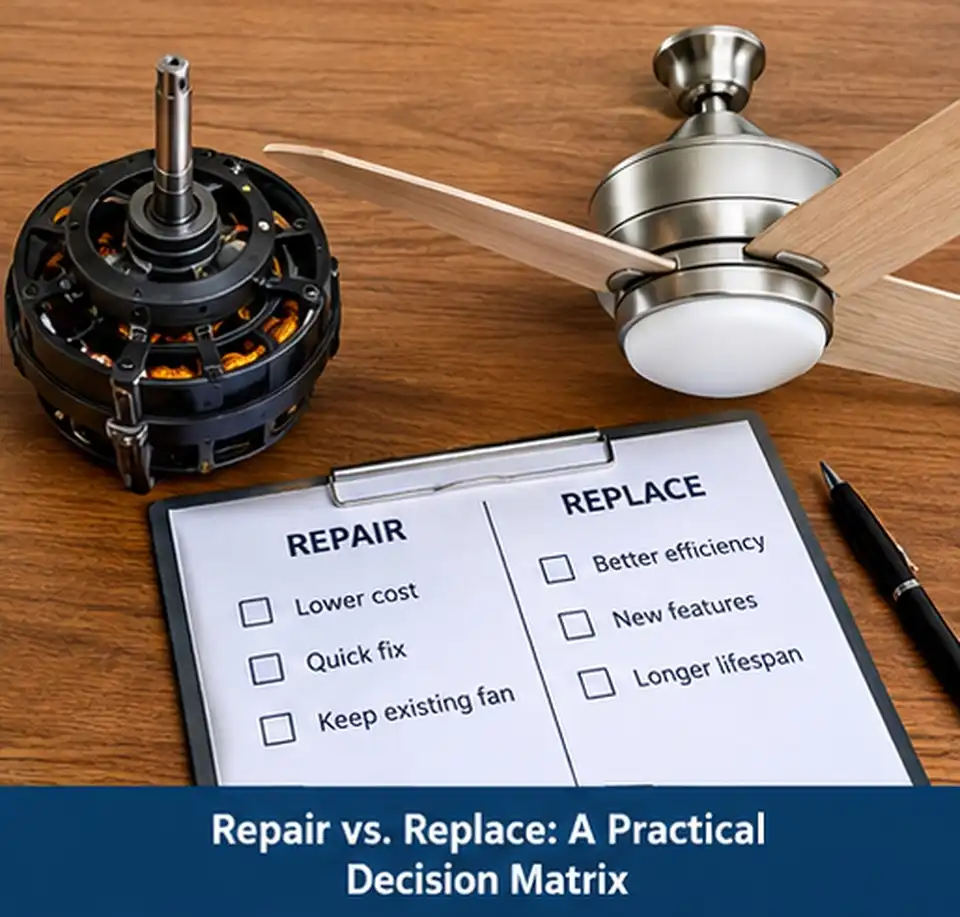
Repair or Replace?
| Factor | Lean Toward Repair | Lean Toward Replace |
|---|---|---|
| Fan age | Under 10 years | 15 years or older |
| Problem type | Capacitor, chain, receiver, loose screws | Burned motor, cracked housing |
| Repair cost | Under 50% of a comparable new fan | Over 50% of a comparable new fan |
| Parts | Available from the maker | Discontinued or no-name parts |
| Efficiency | Already efficient or DC motor | Older AC motor with high wattage |
| Mount | Already on a fan-rated box | Box needs replacing anyway |
| Location | Indoor fan used indoors | Indoor fan rusting on a porch |
Pros and Cons of Repairing
Pros
- Lower upfront cost for common parts
- Keeps a fan that matches your room and décor
- Faster than shopping for and installing a new fan
Cons
- Older motors keep using more power
- Repeat failures on aging fans add up
- Some parts are hard to source
Pros and Cons of Replacing
Pros
- Newer DC motors use less power and run quieter
- Built-in remotes and smart controls
- Fresh warranty
Cons
- Higher upfront cost
- May require a new box, brace or wall control
- Old fixture disposal
What ENERGY STAR Says About Efficiency
According to ENERGY STAR’s ceiling fan guidance, certified fans use improved motors and blade designs and are independently tested for efficiency. That matters when you compare a repair against an upgrade.
| ENERGY STAR Fact | What It Means for Your Home |
|---|---|
| Up to 44% more efficient than conventional fans | Lower running cost over thousands of summer hours |
| Improved motors and blade designs | Better airflow per watt, often quieter |
| Independent certification | Efficiency claims are verified, not just marketed |
| Current specification effective June 15, 2018 | Fans certified under today’s standard |
If replacement wins, the work shifts from repair to installation. Our partners handle new fans through ceiling fan installation for Birmingham homes, including fan-rated boxes, bracing and separate wall controls for fan and light.
Wiring and Mounting Safety: What Our Partners Check
A ceiling fan is heavy and it moves. A box built for a 3-pound light fixture will not stay tight under a spinning 15- to 50-pound fan. Our certified electricians frequently see this in older Birmingham homes where a fan was swapped in for a light decades ago. The fan looks fine until the screws work loose.
The Mounting Checklist
- Box is listed for fan support, usually marked on the box
- Box or brace is fastened to framing, not just drywall or plaster
- Downrod length keeps blades about 7 feet above the floor
- Blade clearance from walls, doors and cabinets
- Canopy screws and ball mount fully seated
The Wiring Checklist
- No backstabbed connections or loose wire nuts
- Ground wire connected where the circuit has one
- Correct control type for the motor, never a standard light dimmer
- Enough conductors between switch and ceiling for separate fan and light control
- No heat damage on insulation inside the box
Older homes add another layer. Cloth-insulated cable, missing grounds and knob-and-tube wiring show up inside ceiling boxes in Highland Park, Forest Park and parts of Bessemer and Fairfield. If the wiring is brittle, a fan repair alone won’t make the room safe. Talk with your electrician about whole-house and partial rewiring options, which can be done room by room.
Code Notes for Ceiling Fan Repair Birmingham AL Homeowners in Jefferson and Shelby Counties
Code requirements depend on the edition your city or county enforces. Your electrician should confirm what applies to your address. These notes are general, not a substitute for a local permit check.
| Code Topic | Typical Requirement | When It Applies |
|---|---|---|
| Fan-rated box | Box must be listed for fan support | Any fan mounted on a ceiling box |
| AFCI protection | Arc-fault protection on bedroom and living area circuits | Often triggered when wiring is new, extended or modified |
| GFCI protection | Ground-fault protection in damp or wet areas | Bathrooms, some porches and outdoor spaces, per fan listing and local code |
| Damp or wet rating | Fan must carry the right UL location rating | Covered porches need damp, exposed areas need wet |
| Permits | Often needed for new circuits or new fan locations | Like-for-like repairs usually don’t need one, but check locally |
Local Notes
- Jefferson County cities, including Birmingham, Bessemer and Fairfield, handle permits through their own building departments.
- Shelby County communities such as Pelham, Alabaster, Helena and Chelsea have their own permit offices.
- Unincorporated areas may fall under county rules instead of city rules.
Before anyone works on your fan, look up the contractor with the Alabama Electrical Contractors Board. Ask for a license number and proof of insurance. It takes a few minutes and protects you.
When a Fan Problem Is Really a Circuit Problem
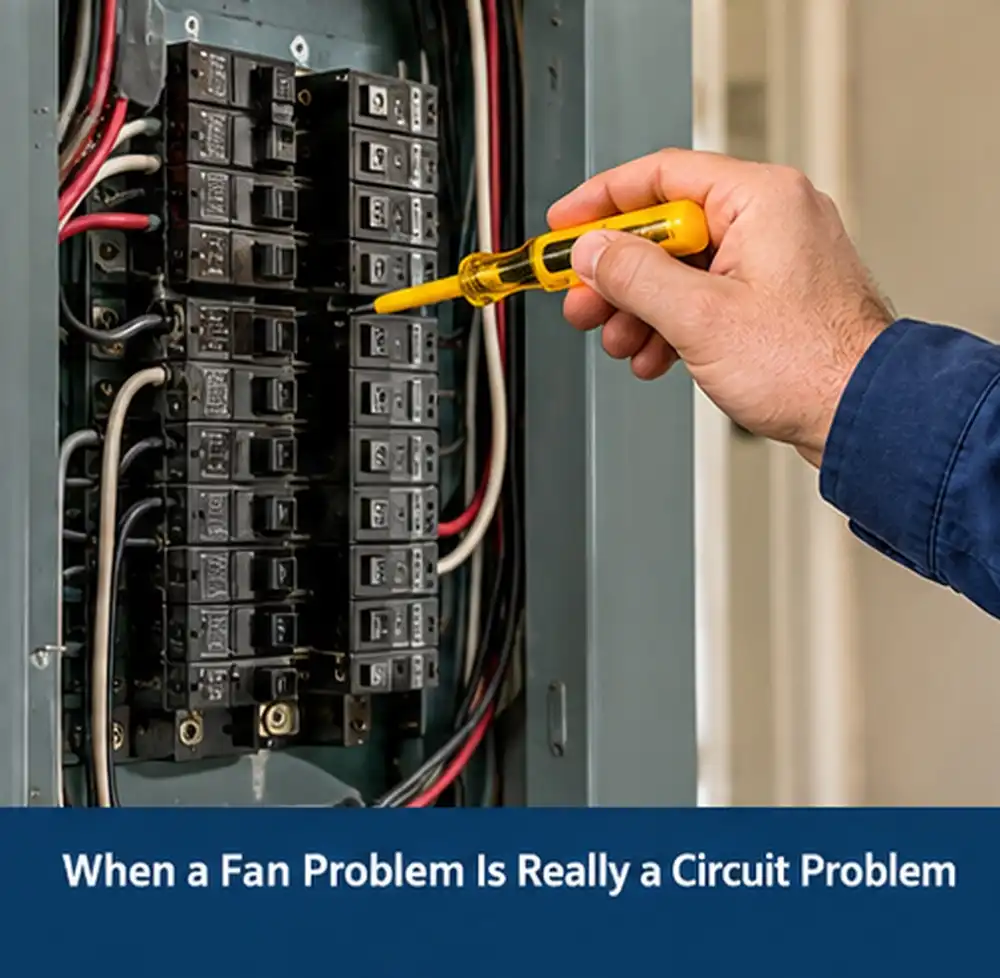
Sometimes the fan is only the messenger. A fan that slows when the AC kicks on, or a breaker that trips when the fan and window unit run together, signals a circuit or capacity issue. Lights dimming across the house, warm breakers and a panel with no open spaces all point the same way. Fixing the fan won’t fix the panel.
Signs the Issue Is Bigger Than the Fan
- Fan speed drops when large appliances start
- The fan circuit trips on hot afternoons
- Adding a new fan circuit isn’t possible because the panel is full
- The home still runs on 60 or 100 amp service with modern loads
Central Alabama’s long cooling season puts steady strain on older electrical service. If your electrician says a new fan circuit won’t fit, ask about an electrical panel upgrade based on a load calculation. Sometimes the answer is more breaker space, sometimes more capacity.
Seasonal Maintenance for Birmingham’s Humid Climate
Humidity, dust and pollen build up fast on blades and inside housings here.
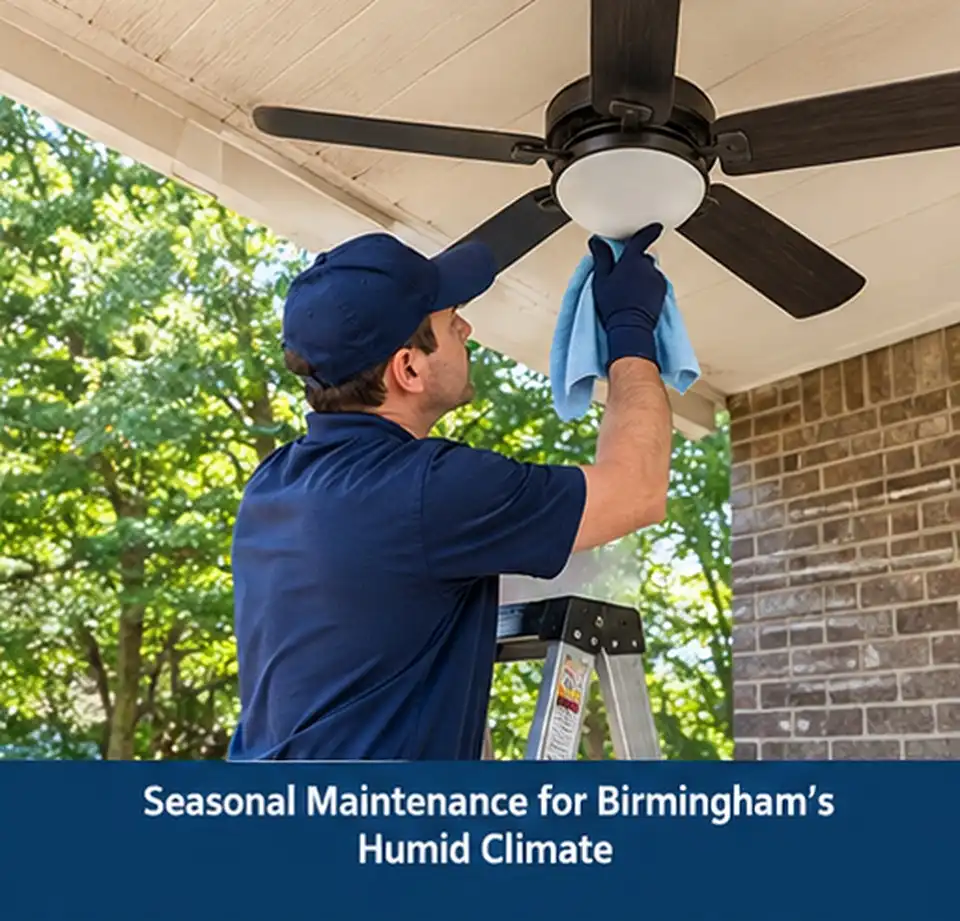
That buildup throws off blade balance and makes the motor work harder. A few simple habits keep fans running longer. Most of this takes five minutes per fan.
Seasonal Fan Settings for Central Alabama
| Season | Direction (looking up) | Speed | Why |
|---|---|---|---|
| Spring (March to May) | Counterclockwise | Low to medium | Mild cooling, saves AC run time |
| Summer (June to September) | Counterclockwise | Medium to high | Wind-chill effect lets you raise the thermostat |
| Fall (October to November) | Counterclockwise or off | Low | Shoulder season, light air movement |
| Winter (December to February) | Clockwise | Low | Pushes warm air down without a draft |
Maintenance Checklist
- Dust blades monthly in summer, using a pillowcase to trap debris.
- Tighten blade screws twice a year with the breaker off.
- Test every speed and the reverse switch when seasons change.
- Check the canopy for movement or new noises.
- Wipe porch fans to slow corrosion from humidity.
- Inspect remote batteries before summer starts.
- Turn fans off in empty rooms, since fans cool people, not rooms.
Storm Season Tips
- Unplug or switch off sensitive fan controls during severe storms if you can do it safely.
- Test remote receivers after storms, since surges damage them often.
- Consider whole-home surge protection if fan receivers, HVAC boards or electronics fail after lightning.
How BirminghamALElectrician.com Connects You With Help
At Birmingham AL Electrician, we keep it simple. We are a referral website, not a crew. When you call us for ceiling fan repair Birmingham AL help, the call routes to an independent local electrician who serves your area. You stay in control of the quote, the schedule and the work.
What Happens When You Call
- Call from any page. The call routes to a participating electrician near you.
- Describe the problem. Share your address, the fan symptoms and anything you noticed.
- Get a look at the fan. If a visit makes sense, the electrician inspects and explains options.
- Agree on the work. Pricing and scheduling are agreed directly with the provider you choose.
What to Have Ready
- Fan brand and model, if you know it
- Ceiling height and room location
- What the fan is doing, and when it started
- Whether a breaker tripped or you noticed a smell
- Approximate age of the home
After-hours and emergency help depends on provider participation, location and availability, so it is never guaranteed.
Service Areas
Coverage depends on which providers participate at your address, and calling confirms it.
| Area | Communities |
|---|---|
| Birmingham & West Jefferson | Birmingham, Fairfield, Bessemer, McCalla |
| North Shelby County | Pelham, Helena, Maylene, Alabaster |
| South Shelby County | Calera, Montevallo, Columbiana, Shelby |
| Highway 280 & East Shelby | Chelsea, Westover, Harpersville, Sterrett, Vandiver |
| Leeds, Springville & Blount County | Leeds, Springville, Remlap, Oneonta |
FAQs
How fast can I get ceiling fan repair Birmingham AL service?
It depends on provider availability in your area and the time of day. Many electricians can schedule within a day or two, and some offer same-day visits. Call with your address to find out who serves you.
Is a wobbling ceiling fan dangerous?
It can be. Blade imbalance is usually harmless, but a moving canopy or sagging fan means the mount is failing. Turn the fan off and have the box checked.
Why does my ceiling fan hum?
The most common causes are a failing capacitor or a standard light dimmer controlling the motor. Fan motors need a fan-rated speed control. If the hum continues after removing the dimmer, the capacitor or motor likely needs attention.
Can I replace a pull chain switch myself?
It involves working inside the switch housing with live-circuit wiring. Because mistakes can cause shorts or shocks, we recommend a licensed electrician. Alabama licenses electrical contractors through the state board.
How long does a typical fan repair take?
Most repairs take one to two hours. High ceilings, plaster ceilings or hidden wiring damage can add time.
Should I repair or replace a 15-year-old fan?
If the motor is failing or parts are discontinued, replacement usually makes more sense. A newer ENERGY STAR certified fan can be up to 44% more efficient. If the fix is a cheap capacitor or chain, repair is still reasonable.
Do I need a permit for ceiling fan repair?
Like-for-like repairs usually don’t need one. New circuits, new fan locations and some wiring changes often do. Ask your electrician to confirm the rules for your city or county.
Can a fan go on a covered porch?
Yes, if it carries a damp rating. Areas exposed to rain need a wet-rated fan. Indoor fans rust and fail quickly outdoors in Birmingham’s humidity.
Get Your Fan Running Right Again
A failing ceiling fan affects your comfort, your cooling bill and sometimes your home’s safety. Most problems trace back to a few parts: capacitors, switches, receivers and mounts. Know the symptoms, check the safe items yourself, and leave the canopy wiring to a licensed pro. A small repair now usually beats a bigger one later.
When you need ceiling fan repair Birmingham AL homeowners can count on, one call is all it takes. Have your address and a short description of the problem ready, and you’ll be connected with an independent local electrician who serves your part of Birmingham, Shelby County or the surrounding communities.
Call Birmingham AL Electrician today at (833) 359-1383. Your call connects you with an independent local electrician who serves your area.